

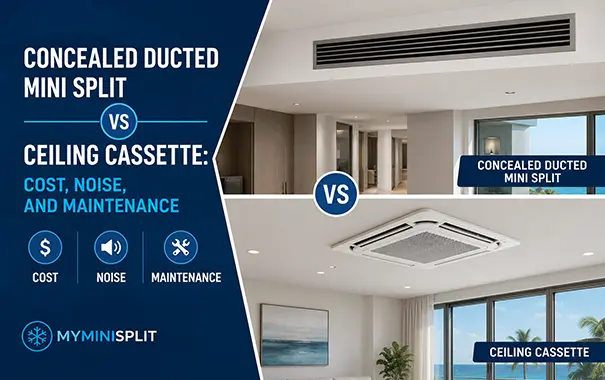
Choose a ceiling cassette when one open room needs cooling and a suitable ceiling location is available. Choose a concealed ducted mini split when you need air delivered through separate grilles, especially to nearby enclosed rooms. A ducted unit often takes more design and installation work, but neither option is always cheaper or quieter. The installed layout determines both.
The difference is easy to miss in product photos. Both units hide most of their equipment above a ceiling. Only the cassette sends air directly into the room from its ceiling panel. A concealed ducted unit sends air through ducts to one or more supply grilles and draws it back through a return path.
That distinction affects the quote, the sounds you hear, and the parts you will need to reach for maintenance. Here is how to compare them for your home.
Concealed ducted vs ceiling cassette at a glance
| Question | Concealed ducted mini split | Ceiling cassette |
| How does air enter the room? | Through one or more supply grilles connected by ducts | Directly through the cassette’s ceiling grille |
| Can one indoor unit serve nearby enclosed rooms? | Possibly, with a designed supply and return path | Generally no; walls and closed doors block its room airflow |
| What remains visible? | Supply and return grilles | The cassette panel in the ceiling |
| What adds to installation cost? | Ducts, grilles, return-air design, insulation, and access | Ceiling opening, support, panel placement, and drainage |
| What affects noise? | Blower location, ducts, return grille, supply grilles, and airflow | Fan, discharge airflow, location, and possibly a drain pump |
| Where is the filter? | At a return grille or air handler, depending on the design | Usually behind the ceiling panel |
| What needs service access? | Air handler, filter, coil, drain, and duct connections | Panel, filter, coil, drain, and any pump |
These are differences between installation types. Capacity, efficiency, sound ratings, and included parts depend on the exact model and outdoor-unit combination.
What is a concealed ducted mini split?
A concealed ducted mini split has an indoor air handler hidden in a ceiling space, soffit, closet, or other suitable location. The air handler conditions room air, then a fan moves it through ducts to supply grilles. Air must also have a planned route back to the unit.
The ducts can be short, but “short” does not mean they can be improvised. Their length, size, bends, grilles, and filter arrangement create resistance to airflow. The selected unit must be able to move the required air through that design.
This style can be useful when you want the indoor equipment out of sight or need to deliver cooling to two nearby enclosed rooms. It does not automatically give each room its own temperature setting. One air handler commonly serves one control zone unless the system includes an approved zoning design.
Browse My Mini Split’s concealed mini split collection to see the type of equipment available. Check whether a listing is a complete system or an indoor section intended for a compatible outdoor unit before comparing prices.
What is a ceiling cassette mini split?
A ceiling cassette places its indoor body above the finished ceiling. Its panel remains visible and distributes air directly into the space below. Some models use four-way airflow; others use a different discharge pattern.
A cassette can fit an open living or dining area where a central ceiling location gives air a clear path across the space. It can also preserve wall space in a room with large windows or built-in furniture.
A standard cassette does not use a duct network to send supply air into separate bedrooms. It may influence a connected open area, but a closed door changes the airflow. See Can One Mini Split Cool Two Rooms? if your plan depends on one unit reaching more than one space.
You can compare available configurations in the ceiling cassette mini split collection. Confirm the listed package contents and the exact model’s airflow pattern before selecting one.
Which option costs more to install?
A concealed ducted system often costs more to install when both options are being quoted for the same open room. Its price may include supply ducts, a return path, insulation, grilles, a filter location, an access panel, and more commissioning work. A cassette avoids that duct design but still requires a suitable ceiling opening, secure support, drainage, and access for service.
The answer changes when the job involves multiple enclosed rooms. Comparing one ducted air handler serving two nearby rooms with one cassette in only one room is not an equal comparison. A fairer alternative may be two cassettes, two wall-mounted heads, or another two-zone arrangement. Each has its own equipment and installation costs.
Ask for an itemized quote
Have each contractor list:
- The exact indoor and outdoor model numbers.
- The room-by-room cooling loads used for selection.
- The supply and return layout, if proposing a ducted unit.
- Duct size, route, insulation, sealing, and grille locations.
- Ceiling work, structural support, and access openings.
- Refrigerant lines, electrical work, and controls.
- Condensate drain, pump if needed, and overflow protection.
- Airflow setup, testing, and system commissioning.
- Filter location and the space needed for future service.
A lower equipment price can become a higher installed price if the ceiling must be opened across several rooms. An inexpensive cassette quote may also be missing the work needed to make its drain or service access practical. Compare the completed designs, not just the product listings.
For a wider look at how indoor-unit choice affects ownership costs, read Single-Zone vs Multi-Zone Mini Split: Which Costs Less Over Time?.
Which one is quieter inside the room?
Neither style is automatically quieter. A concealed ducted unit puts its blower away from the supply grille, which may reduce the fan sound heard directly below the unit. You can still hear air moving through a supply grille, noise at the return grille, or vibration carried through the ceiling.
A cassette has its fan at the room’s ceiling. You may hear steady airflow from its panel, especially at a higher fan setting. A pump, when present, may add an intermittent sound. The position of the cassette relative to a bed, desk, or sofa can matter as much as the published sound figure.
Manufacturers publish indoor sound ratings for particular models and operating settings. Those figures are useful, but two catalog numbers may describe different test conditions. They do not tell you how a return grille beside a bed or a restricted duct will sound after installation.
What can make a ducted system noisy?
A ducted design can lose its quiet advantage if:
- A return grille sits directly outside a bedroom.
- Supply or return openings are too small for the required airflow.
- Ducts have tight bends or restrictions.
- The blower must run at a higher setting to overcome duct resistance.
- The air handler or ductwork transfers vibration into the framing.
- A filter becomes clogged and restricts the return path.
The installer should check the selected air handler’s available external static pressure against the proposed duct and grille design. That rating describes how much resistance the unit can handle while delivering its required airflow. Do not assume every concealed unit can serve the same number of grilles or the same duct length.
What should you compare on the quote?
Ask for the indoor sound rating at relevant fan speeds, the proposed air handler location, and the location of every supply and return grille. If quiet sleep is the goal, point out the bed location. If you work from home, show where your desk will sit.
A well-placed cassette can be quiet in one open room. A well-designed concealed unit can keep blower sound farther from the occupied area. Placement and airflow design decide how those advantages translate into your home.
Which option is easier to maintain?
A cassette filter is usually reached by opening its overhead panel. That can be simple with a reachable ceiling and more awkward with a high ceiling or furniture below it. The coil, drain pan, and any pump also need an accessible service path.
A concealed ducted filter may be at a return grille or near the air handler, depending on the design. A reachable return grille can make regular filter changes easy. The hidden air handler still needs enough access for a technician to inspect and clean its coil, fan, drain, and electrical parts.
Ducts add another part of the system to inspect. They should be properly sealed and insulated, and grilles should remain clear. A filter does not remove the need to check for damaged duct connections or moisture around a cold duct.
Before the ceiling is closed, ask someone to demonstrate how the filter comes out and how a technician will reach the drain pan. If that requires removing finished drywall, the access plan needs work.
Follow the selected manufacturer’s filter instructions rather than using one cleaning interval for every home. Usage, pets, dust, and the filter type can change how quickly it loads up.
Florida homes need a closer look at ducts and drains
In Florida, a concealed ducted unit may be installed near a hot, humid attic. If its ducts pass through unconditioned space, sealing and insulation matter. Poorly insulated cold duct surfaces can collect condensation, while leaks can waste cooling and affect room comfort.
The air handler also needs a sound condensate plan. The installer must identify the drain route, any pump, how a blockage will be detected, and how the line will be cleaned. A ceiling cassette has the same basic water-removal responsibility. Neither unit should be hidden behind a finished ceiling with no way to inspect its drain.
Sizing matters for moisture control too. Choosing a larger unit to compensate for a poor duct layout or difficult room shape can create another comfort problem. Start with a room-by-room load calculation, then select equipment that can deliver the required airflow. My Mini Split’s sizing calculator can provide an initial estimate for discussion with an HVAC professional.
Can one concealed ducted unit cool two bedrooms?
It may, if the rooms are close, the combined load fits the equipment, and each room has a properly designed supply and return path. Air delivered into a bedroom needs a route back when its door is closed. The installer must account for that path rather than assuming air will find its way through the hallway.
Both bedrooms will commonly share one air handler and control strategy. If one faces west and gets hot in the afternoon while the other stays shaded, a shared zone may struggle to keep both equally comfortable. Separate indoor zones may be a better fit for different schedules or temperature preferences.
A ceiling cassette in the hallway is generally not a substitute for direct supply air into closed bedrooms. Its airflow is useful in the open area where it is installed; doors and walls remain barriers.
The two-room mini split guide walks through these layout choices in more detail.
What if you want both styles in one house?
You may prefer a ceiling cassette in an open living area and a concealed ducted unit serving an adjoining suite. Some multi-zone product families allow different indoor styles on one outdoor condenser.
That does not mean any two units from the same brand will work together. The manufacturer must approve the exact indoor and outdoor model numbers, capacities, controls, refrigerant, and connected combination. Drainage and service access must work for each indoor unit too.
Read Can You Mix Wall-Mount, Cassette, Floor, and Concealed Units in One System? before selecting a mixed system. If three areas need conditioning, the three-zone sizing guide explains why their loads should be calculated separately.
Which should you choose?
Choose a ceiling cassette when you have one open room, a suitable ceiling location, a clear airflow path, and a practical drain and service plan. It gives you direct room airflow without the added supply and return ducts of a concealed system.
Choose a concealed ducted mini split when the layout needs supply grilles away from the air handler or direct airflow into nearby enclosed rooms. Budget for the complete duct and return design, not just the hidden unit.
Reconsider both proposals when the quote lacks a load calculation, the ducted plan has no clear return path, the cassette is expected to cool rooms behind closed doors, or either unit will be inaccessible after the ceiling is finished.
For a final decision, ask contractors to draw the airflow and drainage routes on your floor plan. Compare itemized quotes for the same rooms and check the exact equipment specifications. Browse concealed mini splits and ceiling cassette systems, then contact My Mini Split with your room layout and proposed model numbers if you need help comparing available equipment.
Frequently asked questions
Is a concealed ducted mini split better than a ceiling cassette?
It is better when the design needs separate supply grilles or direct airflow into nearby enclosed rooms. A ceiling cassette is often simpler for one open room with a suitable ceiling location. Both need correct sizing, drainage, and service access.
Is a concealed ducted mini split always more expensive?
No. For the same single open room, its ductwork and return-air design often add installation work. For multiple enclosed rooms, compare it against the full cost of the separate indoor units and installation work those rooms would otherwise need.
Which is quieter: a ducted mini split or a ceiling cassette?
Neither has a universal noise advantage. A ducted unit moves its blower away from the supply grille, but air and return-grille noise can still reach the room. Compare model-specific sound data and the proposed grille or cassette locations.
Can a ceiling cassette cool two closed bedrooms?
A standard cassette should not be expected to cool two bedrooms evenly through closed doors. Each room needs a suitable direct air supply, such as its own indoor unit or a properly designed ducted arrangement.
Does a concealed ducted mini split need a return vent?
It needs a designed path for room air to return to its indoor air handler. The return location and route depend on the approved equipment and duct design, especially when doors between rooms may be closed.
Which one is easier to clean?
A cassette filter is accessed overhead through its panel. A ducted system’s filter may be easy to reach at a return grille, but its hidden air handler needs a separate service opening. Check the actual filter and access locations on the installation drawing.