

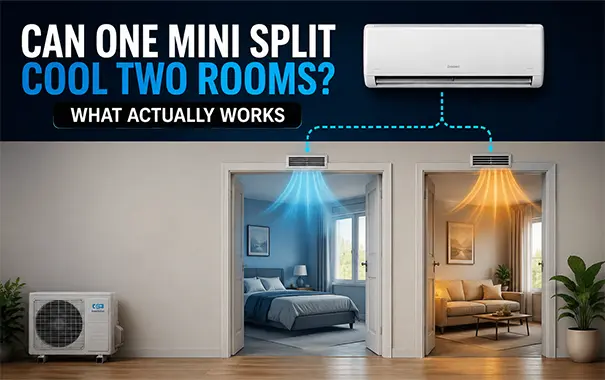
A mini split can sometimes cool two rooms, but only when the rooms function more like one connected space. An open living and dining area, for example, may be comfortable with one correctly sized indoor unit because air can circulate freely between both areas. Two separate bedrooms with doors, hallways, or different cooling needs are another story.
A single wall-mounted mini split is designed primarily to condition one zone. Increasing the BTU rating does not automatically solve an airflow problem because cool air still needs a clear path into the second room. If you need reliable comfort in two enclosed rooms, a multi-zone mini split system with an indoor unit in each room is usually the more effective solution.
Quick Answer: Can One Mini Split Cool Two Rooms?
One mini split may cool two rooms reasonably well when:
- The rooms share a wide, permanently open connection.
- Both areas have similar sun exposure and cooling requirements.
- Air can circulate without passing through a narrow hallway.
- The total cooling load has been calculated correctly.
- The second area does not require separate temperature control.
One indoor unit is unlikely to cool two rooms evenly when:
- A door separates the rooms.
- One room receives considerably more afternoon sun.
- The rooms are on different floors.
- The second room is around a corner or down a hallway.
- Each occupant wants a different temperature.
- Both rooms must remain comfortable with the doors closed.
The important distinction is between cooling two areas and controlling two zones. A single indoor unit may influence an adjoining space, but it cannot provide the same balanced, independent comfort as two indoor units.
Why One Mini Split Often Struggles With Two Separate Rooms
A ductless mini split does not distribute conditioned air through a network of supply and return ducts. Instead, the indoor unit takes in air from the room, cools or heats it, and sends it back into that same space.
This works efficiently in one room because the air can circulate back to the unit. When a wall, closed door, or narrow opening separates a second room, that circulation pattern is interrupted.
The Temperature Sensor Is in One Zone
The indoor unit measures temperature in or near the room where it is installed. Once that room reaches the set temperature, the system can reduce its output even if the adjoining room is still warm.
Placing a larger unit in the first room does not change where the temperature is measured. It may simply cool the first room faster while the second remains uncomfortable.
Air Does Not Turn Corners Easily
Cold air can move through a large doorway, but it does not distribute evenly through narrow halls or around several corners. Furniture, curtains, partial walls, and room layout can restrict airflow even when the door remains open.
A ceiling fan or transfer fan may improve circulation, but it cannot provide the same direct airflow as an indoor unit installed in the second room.
The Rooms May Have Different Cooling Loads
Two rooms of similar size can still require different amounts of cooling. A west-facing bedroom with large windows may gain considerably more heat than a shaded home office. Ceiling height, insulation, occupancy, electronics, and exterior walls also affect the load.
Before selecting any system, use a detailed guide to choose the right mini split size for each room. Sizing the system only from the combined square footage can produce uneven temperatures and poor humidity control.
Closed Doors Stop the Air Exchange
Leaving a bedroom door open may allow some conditioned air to enter, but that arrangement depends entirely on occupant behaviour. The temperature can change quickly when someone closes the door for privacy, sleep, noise control, or security.
If both rooms need dependable comfort with their doors closed, treat them as separate zones.
When One Mini Split Can Cool Two Rooms Successfully
A single indoor unit can work when the layout allows both spaces to behave as one larger zone.
Open Living and Dining Areas
An open living room and dining room usually share the same air volume. If there is no full-height wall or narrow doorway between them, one properly positioned unit may distribute air throughout both areas.
The indoor unit should face the longest open path instead of blowing directly toward a nearby wall. A ceiling fan can help mix the air, especially in rooms with high ceilings.
A Bedroom With a Small Attached Area
A bedroom connected to a small dressing area, reading nook, or open workspace may be served by the same unit. This is more likely to work when the attached area is small, has a wide opening, and does not have a heavy independent heat load.
A compact 9,000 BTU mini split may suit some smaller connected spaces, but square footage alone should not determine the final capacity.
A Studio or Open-Plan Apartment
A studio apartment can often be treated as one zone because there are few interior barriers. Kitchens and large sun-facing windows can add substantial heat, however, so the system must account for more than the floor area.
Depending on the actual load, a 12,000 BTU mini split or a larger unit may be appropriate. A professional load calculation is especially valuable in hot and humid climates.
Two Rooms Served by a Concealed Ducted Unit
A concealed ducted mini split is different from a standard wall-mounted head. It can use short duct runs to deliver air directly to two nearby rooms, provided the system is designed for that application.
This can be an attractive solution when you want one indoor unit hidden above a ceiling while still supplying both rooms directly. Explore concealed mini split options if wall-mounted heads are not suitable for the layout.
What Actually Works: Four Setup Options Compared
| Setup | Best for | Works with closed doors? | Individual temperature control? | Main consideration |
| One wall-mounted single-zone unit | Open or closely connected spaces | Usually no | No | Depends heavily on airflow |
| One unit assisted by a transfer fan | Small adjoining spaces | Sometimes | No | Adds noise and still may be uneven |
| One dual-zone mini split | Two separate rooms | Yes | Yes | Requires one indoor head per room |
| One concealed ducted mini split | Two nearby rooms with ceiling access | Yes | Usually one shared setting | Requires short ductwork and careful design |
Option 1: Use One Single-Zone Unit for a Truly Open Space
A single-zone mini split is the simplest choice when the two areas have no meaningful barrier between them. This setup has one outdoor condenser and one indoor unit.
It can be cost-effective and efficient, but only if the unit is correctly sized and positioned. Choosing an oversized system to force more air into the second area can create short cycling, temperature swings, and inadequate moisture removal.
Option 2: Install a Dual-Zone Mini Split
For two enclosed rooms, a dual-zone system is generally the most practical solution. It uses one outdoor condenser connected to two indoor units. Each room receives direct conditioned air and has its own temperature sensor and controller.
MyMiniSplit offers two-zone mini split systems with different indoor-unit combinations. For example, two similarly sized rooms might use matching indoor heads, while a small bedroom and a larger living area may need different capacities.
The outdoor unit and indoor heads must be compatible, and their capacities should be selected from room-by-room load calculations rather than guesswork.
Option 3: Install Two Separate Single-Zone Systems
Two independent single-zone systems can also cool two rooms effectively. Each room receives its own indoor and outdoor unit, so the systems operate separately.
This arrangement can provide:
- Fully independent operation.
- Easier expansion if the rooms are upgraded at different times.
- Continued cooling in one room if the other system needs service.
- Strong efficiency when each system is closely matched to its room.
The tradeoff is that you need space for two outdoor condensers, two electrical connections, and two sets of refrigerant lines. A dual-zone system is often more attractive where outdoor space is limited.
Option 4: Use a Concealed Ducted Mini Split
A concealed indoor unit can supply two nearby rooms through short ducts. This is one of the few ways a single indoor mini split unit can intentionally serve two enclosed rooms.
It works best when:
- The rooms are close together.
- There is accessible ceiling or attic space.
- Both rooms can use the same operating schedule.
- Supply and return airflow are designed correctly.
- The total room load stays within the unit’s capacity.
This solution requires more design work than a wall-mounted mini split, but it provides a cleaner appearance and direct airflow to both rooms.
Does a Larger Mini Split Solve the Problem?
Not necessarily. BTU capacity measures how much heat the system can remove; it does not determine whether the air can reach a second room.
An 18,000 BTU mini split installed in one bedroom will not automatically cool another bedroom behind a closed door. It may cool the first room very quickly, causing the system to reduce output before enough conditioned air reaches the second space.
Oversizing can be particularly troublesome in humid areas. If the room temperature drops too quickly, the system may not run long enough to remove moisture effectively. The result can be a cool but clammy room.
The right solution is to calculate the cooling load for each room and then choose a system that delivers air directly where it is needed.
Can a Fan Help One Mini Split Cool Two Rooms?
A fan can help in certain layouts, but it should be viewed as an airflow aid rather than a complete zoning solution.
A ceiling fan can mix air within an open space. A doorway fan or through-wall transfer fan can move air between adjoining rooms. For the best chance of success, cooler air should enter the second room while warmer air has a clear path back toward the mini split.
However, a fan may not solve:
- Different temperature preferences.
- Closed-door airflow restrictions.
- Unequal sun exposure.
- High heat from computers or appliances.
- Significant differences in room size.
- Humidity problems in the second room.
If a second room must remain consistently comfortable, an additional indoor head is more reliable than depending on a portable or transfer fan.
How to Choose the Right Setup
Ask these questions before deciding whether one mini split can cool two rooms:
- Are the rooms separated by a door or hallway?
- Will the door remain open whenever cooling is needed?
- Does one room receive more direct sunlight?
- Are the rooms used at the same time?
- Do the occupants prefer different temperatures?
- Does either room contain heat-producing equipment?
- Is there a clear path for air to return to the indoor unit?
- Is there room outside for one or two condensers?
- Is ceiling space available for a concealed ducted unit?
- Has a room-by-room cooling load been calculated?
If the rooms are enclosed or have noticeably different loads, choose a dual-zone system or separate single-zone units. If they form one open area, a correctly sized single-zone system may be enough.
Energy Use: Is One Unit Always Cheaper?
One indoor unit may cost less to purchase and install, but it is not automatically the most economical long-term choice. A poorly planned system may run for extended periods while the second room remains uncomfortable. Occupants may also set the thermostat unnecessarily low in an attempt to push more cooling into the adjoining room.
A properly sized multi-zone system can direct cooling to the rooms that need it. You can reduce the setting in an unused room while maintaining comfort in the occupied room. For additional operating guidance, read Should You Leave Your Mini Split Running All Day?
Compare the complete installation, expected usage, maintenance needs, and available outdoor space—not just the number of indoor units.
Final Answer
Can one mini split cool two rooms? Yes, but mainly when those rooms share an open layout and behave like one zone. A single wall-mounted unit is not a dependable solution for two enclosed bedrooms, separate offices, or rooms with different heat loads.
For consistent comfort with closed doors, choose a dual-zone system with one indoor unit per room, install two separate single-zone systems, or consider a concealed ducted mini split. Proper room-by-room sizing and direct airflow matter more than simply buying a larger BTU unit.
Explore MyMiniSplit’s multi-zone mini split systems to compare configurations designed for two or more rooms.
Frequently Asked Questions
Can a 12,000 BTU mini split cool two bedrooms?
A 12,000 BTU unit may have enough theoretical capacity for the combined square footage of two small bedrooms, but it will not cool them evenly if walls and closed doors block the airflow. Two indoor heads or a properly designed concealed ducted unit will produce more reliable results.
Can an 18,000 BTU mini split cool two rooms?
It depends on the layout and total cooling load. An 18,000 BTU unit can condition a large open zone, but higher capacity does not make air move effectively through walls, hallways, or closed doors.
Can one mini split cool an entire small house?
A single wall-mounted unit may influence an open, compact home, but bedrooms and other enclosed rooms can remain warmer. A multi-zone system, multiple single-zone units, or a ducted mini split is usually more effective for whole-home comfort.
Can one mini split cool upstairs and downstairs?
Generally, no. Air movement between floors is difficult to control, and warm air naturally rises. Separate indoor units for each floor provide much better temperature control.
Will leaving both bedroom doors open work?
It may help, especially if the rooms are close to the indoor unit, but temperatures can still vary. The arrangement stops working whenever a door is closed, and the mini split’s sensor will still measure the temperature in only one location.
Do both indoor units in a dual-zone system work independently?
Each indoor unit can usually have its own temperature setting and fan control. However, many multi-zone heat pump systems require connected units to operate in compatible modes, such as all cooling or all heating. Check the specific model’s controls and compatibility before purchase.
Can a ceiling cassette cool two rooms?
A ceiling cassette can distribute air effectively across a large open area, but interior walls still block airflow. A cassette should not be expected to cool two enclosed rooms unless the system includes a suitable ducted distribution design.