
Mini Split Articles

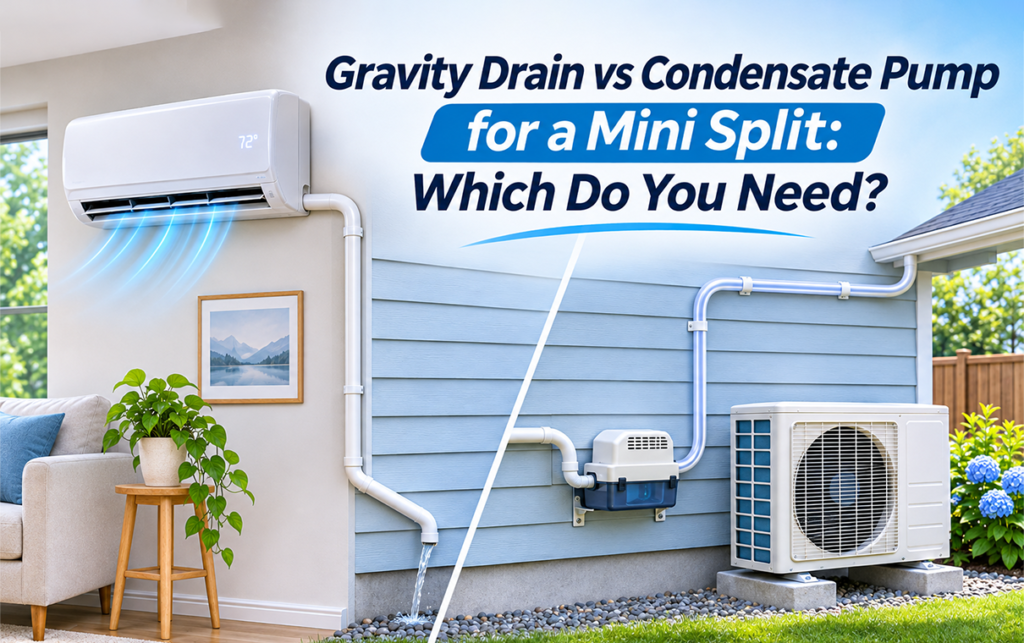
Mini split drainage layouts showing a sloped gravity drain and a condensate pump with an upward discharge tube

Gravity Drain vs Condensate Pump for a Mini Split: Which Do You Need?

Use a gravity drain when water can flow downhill from the indoor unit to an approved discharge point along the entire route. Choose a condensate pump when the route requires water to rise or a practical gravity path is unavailable. If the indoor unit already includes a lift pump, check its limits before buying an […]

Gravity Drain vs Condensate Pump for a Mini Split: Which Do You Need? Read More »
Mini split copper tubes showing common outside diameters from 1/4 to 3/4 inch

Mini Split Line Set Size Guide: Understanding Common Copper Pipe Sizes

Choose the copper pipe diameters specified for your exact mini split model. Common line set pairs include 1/4 × 3/8 inch, 1/4 × 1/2 inch, and 3/8 × 5/8 inch, but systems with the same BTU rating can require different sizes. Check both the indoor and outdoor model numbers before ordering. The two numbers describe

Mini Split Line Set Size Guide: Understanding Common Copper Pipe Sizes Read More »

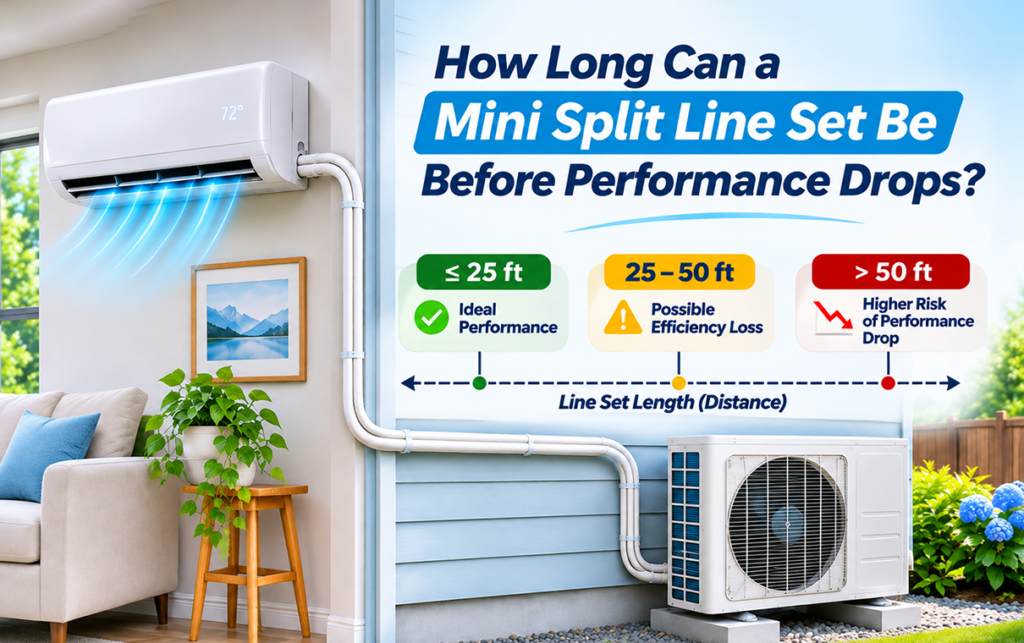
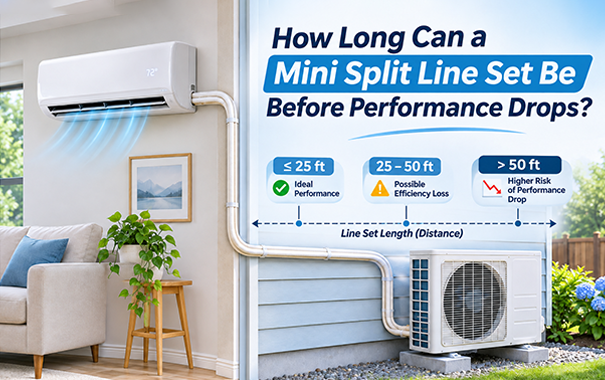
Mini split refrigerant lines routed from an indoor unit to an outdoor condenser

How Long Can a Mini Split Line Set Be Before Performance Drops?

There’s no universal distance where a mini split starts losing performance. A 50-foot line set may be the maximum for one model and well within the limit for another. Cooling capacity can drop before you reach that limit. Use the installation manual to find out whether your route is allowed, then check the manufacturer’s performance

How Long Can a Mini Split Line Set Be Before Performance Drops? Read More »

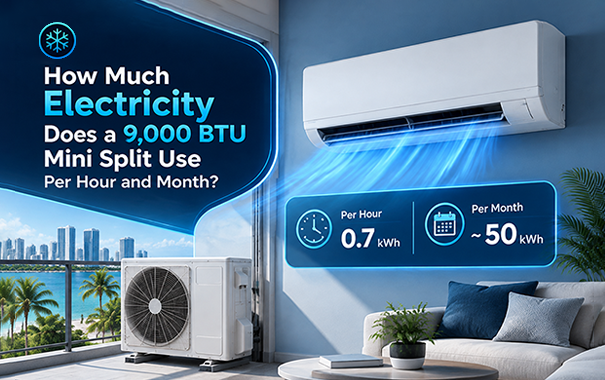
9,000 BTU mini split with hourly and monthly electricity use calculations

How Much Electricity Does a 9,000 BTU Mini Split Use Per Hour and Month?

A 9,000 BTU mini split does not have one fixed electricity draw. One current model has a published cooling input of 680 watts, which would use 0.68 kilowatt-hours in an hour at that draw. At an illustrative electricity rate of $0.15 per kWh, that costs 10.2 cents per hour. A system averaging 500 watts over

How Much Electricity Does a 9,000 BTU Mini Split Use Per Hour and Month? Read More »

Wall-mounted mini split with a thermometer and an operating-cycle log

Mini Split Turns On and Off Every Few Minutes: Is It Short Cycling?

A mini split turning on and off every few minutes may be short cycling, but intermittent airflow alone does not prove it. The concern is repeated brief compressor runs—not simply the indoor fan changing speed or stopping. Check whether the room reaches its set temperature, whether the system shows an error, and what the exact

Mini Split Turns On and Off Every Few Minutes: Is It Short Cycling? Read More »

Florida sunroom with glass walls, afternoon sun, and a wall-mounted mini split

Mini Split for a Florida Sunroom: How Glass and Sun Exposure Change BTU Needs

A mini split can cool an enclosed Florida sunroom, but its BTU needs depend on much more than floor area. Large glass walls, the glass’s solar heat gain rating, afternoon sun, roof construction, and outdoor air leakage can make a sunroom need substantially different capacity from a bedroom of the same size. Choose the system

Mini Split for a Florida Sunroom: How Glass and Sun Exposure Change BTU Needs Read More »

Mini split placement and condensate drainage plan for a Miami condo

Mini Split for a Miami Condo: HOA, Drainage, Noise, and Placement Guide

A mini split can work in a Miami condo when your condominium association allows the installation, the building has an approved outdoor-unit location, and the design meets permit, drainage, noise, and access requirements. Get the installation route approved before buying equipment. A balcony, exterior wall, or roof is not automatically available just because it serves

Mini Split for a Miami Condo: HOA, Drainage, Noise, and Placement Guide Read More »

Mini split installation permit checklist for a Miami-Dade County home

Do You Need a Permit to Install a Mini Split in Miami-Dade County? 2026 Guide

Yes. A new, permanently installed mini split generally requires a mechanical permit in Miami-Dade County. New or altered electrical work usually requires an electrical permit too. Apply through the building department responsible for your property, and obtain the required approvals before installation starts. For an exact replacement, unincorporated Miami-Dade County allows an electrical permit exemption

Do You Need a Permit to Install a Mini Split in Miami-Dade County? 2026 Guide Read More »

Shopping Cart