

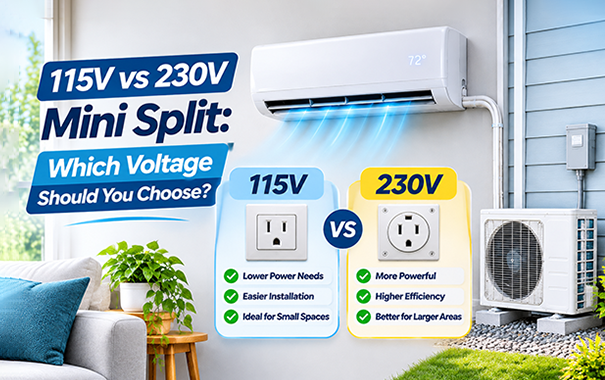
Choose a 115V mini split if it can cool the space and your electrician confirms a suitable dedicated 120V circuit. Choose a 230V model if the system you need calls for it, as is common with larger single-zone and multi-zone systems. If both options fit, compare the total installed price and the efficiency ratings of the exact models. Voltage alone won’t tell you which one costs less to run.
For a Miami condo, confirm whether the building supplies 208V before ordering. Look for a model whose nameplate and installation manual explicitly allow that supply.
115V vs 230V mini splits at a glance
| What to compare | 115V mini split | 230V mini split |
| Supply to verify | Typically a nominal 120V circuit | Typically a nominal 240V circuit in a house, or 208V where the model allows it |
| Typical applications | Smaller single-zone systems, often 9,000 or 12,000 BTU/h | Larger single-zone systems, multi-zone systems, and some smaller single-zone models |
| Typical breaker setup | Single-pole breaker on a dedicated circuit | Double-pole breaker on a dedicated circuit |
| Running cost | Compare the exact model’s efficiency and expected energy use | Compare the exact model’s efficiency and expected energy use |
Those are common setups. Your installer should follow the outdoor unit’s nameplate, the manufacturer’s instructions, and local electrical requirements.
Start with the cooling load, then check the voltage
A bedroom, a garage, and a glass sunroom can have very different cooling needs even when their floor areas match. Ask your HVAC contractor to calculate the load and check the unit’s cooling capacity at local design conditions. ENERGY STAR explains how a Manual J load calculation helps size a ductless system.
In South Florida, ask how the unit will handle humidity during milder, sticky weather as well as heat on the hottest afternoons. Oversizing can lead to short run times and poor moisture removal. Glass area, shade, and afternoon sun can all change the load, as our guide to sizing a mini split for a Florida sunroom explains.
When 115V makes sense
Suppose a load calculation shows that a 12,000 BTU/h single-zone model will meet the needs of an enclosed home office. If a suitable dedicated 120V circuit is already available or is easier to install, a unit such as the MRCOOL Easy Pro 12,000 BTU 115V mini split is one option to compare. Have your electrician confirm the circuit before you order.
When 230V makes sense
Suppose an enclosed addition needs a model in the 18,000 BTU/h class. The MRCOOL Easy Pro 18,000 BTU 230V mini split is one example in that size. MRCOOL’s equipment specifications list 115V for smaller Easy Pro models and 208–230V for larger ones in the catalog. Verify the documentation for the exact outdoor model you plan to buy.
For multiple rooms served by one outdoor unit, start with the condenser’s electrical specs and the manufacturer’s approved indoor-unit combinations. The voltage requirement comes from the equipment configuration. The capacity of one indoor head doesn’t tell you what circuit the outdoor unit needs.
What your electrician should confirm before you order
The actual supply voltage
Product listings may use 110V, 115V, and 120V for the same general supply class. You may also see 220V, 230V, or 240V used for the higher-voltage class. The exact permitted input range still comes from the equipment documentation.
A condo may have 120/208V service, which can provide 120V for ordinary receptacles and 208V between two supply legs. A 230V listing alone doesn’t establish 208V compatibility. Ask your electrician to verify the building supply and match it to the outdoor unit’s approved range. Check the association’s approval process early, too. Our Miami condo mini split guide covers equipment placement, drainage, and what to include in the installation quote.
The circuit, breaker, and disconnect
Give your electrician the outdoor unit’s model number and installation manual. Ask them to check:
- Minimum circuit ampacity (MCA). This helps determine the minimum ampacity the supply conductors must have.
- Maximum overcurrent protection (MOCP). This is the maximum rating for the permitted breaker or fuse, as specified by the manufacturer.
- Panel and circuit suitability. The electrician should verify available panel capacity and space, whether an existing dedicated circuit can be reused, and what wiring and disconnect the job requires.
Many 115V mini splits are hardwired on dedicated circuits. A nearby outlet or an unused breaker position is only one detail in the assessment. Ask for an installed quote that itemizes electrical work, any panel changes, and permit handling. If a new circuit or disconnect is part of the job, confirm the mechanical and electrical permit requirements with the authority for your address. Use our Miami-Dade mini split permit guide to identify where to start.
Is a 230V mini split cheaper to run?
A 230V mini split can draw fewer amps for the same power, but fewer amps alone won’t lower your electric bill. Your bill reflects energy use in kilowatt-hours (kWh). To compare two suitable models, look at the rated SEER2 of the exact indoor and outdoor combination for seasonal cooling efficiency. If you use the mini split for heating, compare HSPF2 as well. Actual consumption also depends on the room’s cooling load, your settings, and how the unit runs.
Hypothetical example. If a 115V unit and a 230V unit each average 700 watts over the same hour, each uses 0.70 kWh. The example assumes equal average input power for that hour. For a fuller estimate, see how to calculate hourly and monthly electricity use for a 9,000 BTU mini split.
Frequently asked questions
Can I plug a 115V mini split into a regular wall outlet?
Only if the manufacturer specifically lists that model for cord-and-plug installation and the circuit meets its requirements. Many 115V ductless systems are hardwired to a dedicated circuit. Check the exact model’s installation manual before buying.
Can a 230V mini split run on 208V?
Yes, if the manufacturer explicitly approves 208V for that exact model. Check the nameplate and installation manual, and have your electrician verify the building supply before you order.
Can I buy a 12,000 BTU mini split in either voltage?
Yes. Some manufacturers offer 12,000 BTU/h models in both 115V and 208/230V versions. Check the full outdoor model number, cooling performance, and electrical specs because the two versions can differ.
Does a 230V mini split need a panel upgrade?
Only if the existing electrical system cannot safely accommodate the required circuit without one. An electrician can check the panel’s available capacity, breaker space, and any existing circuit to determine what work is needed.