

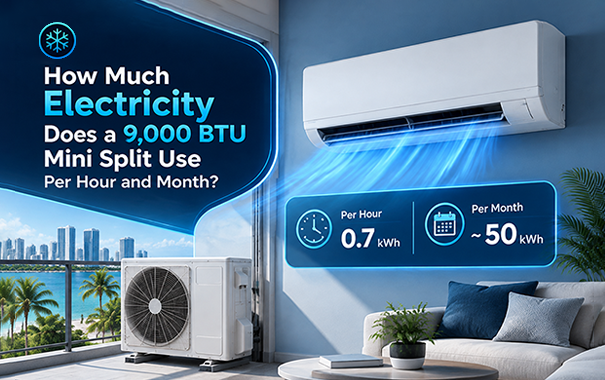
A 9,000 BTU mini split does not have one fixed electricity draw. One current model has a published cooling input of 680 watts, which would use 0.68 kilowatt-hours in an hour at that draw. At an illustrative electricity rate of $0.15 per kWh, that costs 10.2 cents per hour. A system averaging 500 watts over eight scheduled hours a day would use 120 kWh and cost $18 over a 30-day month.
Those numbers are a manufacturer example and a calculation scenario, not a guaranteed range for every 9,000 BTU system. Your actual consumption depends on the model, cooling load, settings, weather, and operating schedule.
For Miami and South Florida homeowners, the biggest question is often how much power the unit averages while keeping the room comfortable—not just the watts listed on a specification sheet.
Quick electricity-use examples
All costs below use $0.15 per kWh as an assumed rate, not a quoted FPL tariff.
| Power assumption | Electricity used in one hour | Cost for that hour |
| 300 watts average | 0.30 kWh | 4.5 cents |
| 500 watts average | 0.50 kWh | 7.5 cents |
| 680 watts held constant | 0.68 kWh | 10.2 cents |
| 900 watts average | 0.90 kWh | 13.5 cents |
The 680-watt figure comes from a specific model described below. The other rows are hypothetical inputs that show how the calculation works. They are not measured minimums, maximums, or typical consumption figures.
What does 9,000 BTU mean?
The “9,000 BTU” label normally means 9,000 BTU per hour of rated cooling capacity. It describes how much heat the system can remove under rating conditions.
It does not mean the system consumes 9,000 watts of electricity.
Keep these three measurements separate:
- BTU/h: cooling or heating output.
- Watts or kilowatts: electrical power being drawn at a particular time.
- Kilowatt-hours, or kWh: electrical energy consumed over a period of time—the quantity used to calculate usage charges on your bill.
A unit drawing 500 watts for two hours uses 1 kWh. A unit drawing 1,000 watts for one hour also uses 1 kWh.
A real 9,000 BTU mini split wattage example
Pioneer’s Quantum Ultra WYT009ALSI24RL, a 115-volt single-zone system, has the following published specifications:
| Specification | Manufacturer’s listed value |
| Rated cooling capacity | 9,000 BTU/h |
| Rated cooling electrical input | 680 watts |
| Rated heating electrical input | 730 watts |
| Cooling SEER2 | 23.0 |
| Cooling EER2 | 13.0 |
These figures appear in the manufacturer’s system submittal sheet. They illustrate why electrical input should come from the exact equipment specifications rather than a universal watts-per-BTU shortcut.
If this system drew 680 watts for eight hours, it would consume:
680 ÷ 1,000 × 8 = 5.44 kWh.
At $0.15 per kWh, that is approximately $0.82 for those eight hours.
An inverter system will not necessarily hold that draw all day. Rated input is a reference point under specified conditions, not a measured daily average or maximum-power limit.
Why inverter mini split power use changes
An inverter compressor adjusts its speed as the room’s cooling demand changes. The indoor and outdoor fans also consume electricity, and their operation can change with the controls.
A room that has been sitting hot may require more output initially. Once it approaches the target temperature, the system may reduce output. If demand falls below the equipment’s minimum stable capacity, the compressor may stop and restart.
That means three different figures can all be relevant:
| Figure | What it tells you |
| Rated cooling input | A published reference for the matched system |
| Maximum electrical input | The manufacturer’s stated upper electrical input, when provided; useful for equipment planning |
| Measured average power | Energy used divided by elapsed time; the useful input for an operating-cost estimate |
An indoor fan running quietly does not reveal the outdoor compressor’s power draw. A unit that is switched on for 24 hours also does not necessarily spend 24 hours at rated input.
Our guide to leaving a mini split running all day covers scheduling and comfort considerations. For cost comparisons, measure energy over the whole schedule, including compressor pauses, rather than guessing how many minutes it ran at full power.
How much electricity does it use per month?
Monthly electricity use = average watts ÷ 1,000 × scheduled hours per day × days in the month.
Use the average power across the entire scheduled period, including low-speed operation and any pauses within that period. Do not multiply that average by an additional guessed compressor duty cycle.
The following are calculation scenarios, not forecasts for a particular room. They use a 30-day month and $0.15 per kWh.
| Average power during scheduled hours | Hours per day | Monthly electricity | Monthly usage cost |
| 300 watts | 8 | 72 kWh | $10.80 |
| 500 watts | 8 | 120 kWh | $18.00 |
| 680 watts | 8 | 163.2 kWh | $24.48 |
| 500 watts | 12 | 180 kWh | $27.00 |
| 500 watts | 24 | 360 kWh | $54.00 |
| 900 watts | 24 | 648 kWh | $97.20 |
For schedules shorter than 24 hours, these figures exclude any electricity used outside the stated hours, such as standby consumption. They also exclude separately powered accessories or a separate dehumidifier.
An eight-hour bedroom scenario
Suppose a bedroom mini split averages 500 watts across an eight-hour overnight schedule:
- Daily energy: 0.50 kW × 8 hours = 4 kWh.
- Monthly energy: 4 kWh × 30 days = 120 kWh.
- Monthly cost at $0.15 per kWh: 120 × $0.15 = $18.
This calculation does not establish that your bedroom will average 500 watts. Sun exposure, insulation, temperature settings, and outdoor conditions determine whether that assumption fits your home.
A system left on around the clock
If the average over a full 24-hour day is 500 watts, daily energy is 12 kWh. Over 30 days, that becomes 360 kWh, or $54 at the assumed rate.
If measured consumption is lower or higher, the cost changes with it. Leaving the controller on all day is not enough information to calculate a bill.
How to estimate the cost on your FPL bill
Electricity cost = additional kWh × the applicable price per kWh.
Check your current bill and FPL’s rates and billing information. Residential billing can include energy charges, fuel charges, other usage-based charges, and fixed monthly charges. Rates can also vary with the plan and usage tier.
When estimating the extra cost of a mini split:
- Estimate or measure the system’s added kWh.
- Include the applicable usage-based charges, not just a single base-energy line on the bill.
- Account for any tier boundary or time-of-use pricing that affects those additional kWh.
- Include applicable taxes and fees when you need a closer bill estimate.
Dividing your entire bill by household kWh gives a rough blended rate. It can help with budgeting, but fixed charges mean it may not equal the price of the next kWh you use.
To see how rate assumptions matter, the same 120 kWh per month costs:
| Assumed electricity rate | Usage cost for 120 kWh |
| $0.12 per kWh | $14.40 |
| $0.15 per kWh | $18.00 |
| $0.20 per kWh | $24.00 |
These are illustrative rates. They do not represent three FPL plans or a prediction of future pricing.
Can you calculate watts from SEER2 or EER2?
SEER2 is a seasonal efficiency rating. EER2 describes cooling efficiency at specified rating conditions. Neither replaces a measurement of your home’s electricity use.
ENERGY STAR’s efficiency definitions explain the distinction between seasonal cooling performance and the cooling-output-to-electrical-input ratio.
EER2 can provide a rating-condition estimate
When the cooling capacity and EER2 refer to the same rating conditions:
Electrical input in watts ≈ cooling capacity in BTU/h ÷ EER2.
For a hypothetical system delivering 9,000 BTU/h at an EER2 of 12:
9,000 ÷ 12 = 750 watts.
This is a calculation at the stated conditions. Use the manufacturer’s published electrical-input data for the exact matched system when available.
SEER2 does not give a fixed hourly draw
Dividing 9,000 by a SEER2 rating of 23 gives about 391. That does not prove a system draws 391 watts every hour, because SEER2 describes performance across a standardized cooling season.
A higher SEER2 can support lower seasonal consumption for comparable cooling loads. It does not tell you the room’s load, operating hours, or exact monthly kWh.
Why electricity use can be higher in a Miami room
Two rooms using the same model can produce very different energy totals.
Conditions that can increase cooling demand include:
- Strong afternoon sun through windows.
- A hot roof or poorly insulated ceiling.
- Outdoor air entering around doors, windows, or other openings.
- Frequent door opening or an open connection to a warmer space.
- Heat from people, computers, cooking, or other equipment.
- A lower temperature setting or more hours of conditioning.
South Florida humidity also matters. Removing moisture is part of the cooling load, and a comfortable temperature alone does not prove the room’s humidity is controlled.
Use a humidity reading alongside the temperature reading. Our guide to mini split temperature and fan settings for Miami humidity explains how to compare settings without relying on aggressive overcooling.
The 9,000 BTU label is not a universal room-size recommendation. Have the room’s peak load and the system’s minimum capacity checked before buying. Start with our guide to choosing the right mini split size, then obtain a room-specific load calculation.
Does this apply to a 9,000 BTU head on a multi-zone system?
A 9,000 BTU indoor head on a shared condenser cannot be assigned the electricity consumption of a separate 9,000 BTU single-zone system.
The outdoor unit serves the connected zones, and its efficiency, minimum output, controls, and active room loads determine system consumption.
Dividing the shared condenser’s energy evenly by the number of heads is not a reliable way to calculate each room’s cost. One operating head also does not necessarily consume one-quarter of a four-zone system’s electricity.
Read our guide to running one indoor unit on a multi-zone mini split if only one room usually needs cooling. The complete indoor-outdoor combination matters more than the capacity label on that head.
How to measure your mini split’s actual electricity use
The most useful number is measured kWh over several representative days.
For a hardwired system, a qualified electrician can install a compatible circuit energy monitor. Confirm that it captures the complete system and handles the circuit voltage and configuration correctly.
Do not connect a hardwired mini split to a household plug-in meter or open an electrical panel to take readings yourself.
Record:
- Total system kWh over the measurement period.
- Scheduled hours and temperature settings.
- Outdoor weather and whether the period was unusually hot.
- Room temperature and humidity.
If your manufacturer’s app reports energy, check whether the figure is metered or estimated. Whole-home utility readings can reveal patterns, but other appliances make it difficult to isolate mini split consumption precisely.
Suppose the circuit monitor records 28 kWh over seven days:
28 ÷ 7 × 30 = 120 kWh for a comparable 30-day month.
At $0.15 per kWh, that projects to $18. Repeat the measurement in hotter weather before treating one mild week’s result as a summer budget.
Ways to reduce use without sacrificing comfort
Reduce the room’s cooling demand before assuming you need a different system. Shade sunny windows, address air leaks, and keep doors to uncontrolled spaces closed when practical.
Keep filters clean according to the manual and maintain indoor and outdoor airflow clearances. Arrange service if cooling performance deteriorates, ice appears, or the equipment develops an unusual operating pattern.
Use schedules or moderate setbacks that fit occupancy and humidity needs. Dry mode is a model-specific humidity tool; it does not guarantee a fixed percentage reduction in electricity use.
If you are comparing equipment, browse our 9,000 BTU single-zone mini split systems after confirming the room’s load. Compare the matched system’s electrical input, efficiency ratings, and modulation range.
For help comparing specifications, contact My Mini Split with the model numbers, room details, and expected schedule.
Frequently asked questions
How many watts does a 9,000 BTU mini split use?
The exact watts depend on the model and operating conditions. The Pioneer WYT009ALSI24RL example in this guide lists 680 watts of rated cooling input. An inverter system’s actual draw changes with demand, so that figure is not a universal average or maximum.
How much does a 9,000 BTU mini split cost to run for eight hours?
At a constant 680-watt draw, it uses 5.44 kWh in eight hours and costs about $0.82 at $0.15 per kWh. If its measured average is 500 watts over those hours, it uses 4 kWh and costs $0.60.
How much electricity does it use if left on 24 hours a day?
Multiply the average power over the full day by 24 hours. A 500-watt daily average uses 12 kWh per day and 360 kWh over 30 days. At $0.15 per kWh, that is $54. The average must be measured or explicitly assumed; being switched on does not establish it.
Does a 230-volt mini split use half the electricity of a 115-volt model?
No. Voltage alone does not determine energy use. If both systems average 680 watts, both use 0.68 kWh in an hour. Compare watts, efficiency, and measured kWh rather than assuming lower current means lower electricity consumption.
Can I use the breaker size to calculate monthly cost?
No. Breaker size, minimum circuit ampacity, and maximum overcurrent protection are electrical installation specifications. They do not describe the system’s average draw. Use published input watts for a labeled estimate or measured kWh for a stronger one.
Does it use the same electricity in heating mode?
Not necessarily. Heating input and efficiency differ from cooling and change with outdoor conditions. Use heating-mode data or measurements for a heating estimate. Cooling SEER2 does not calculate winter electricity consumption.