

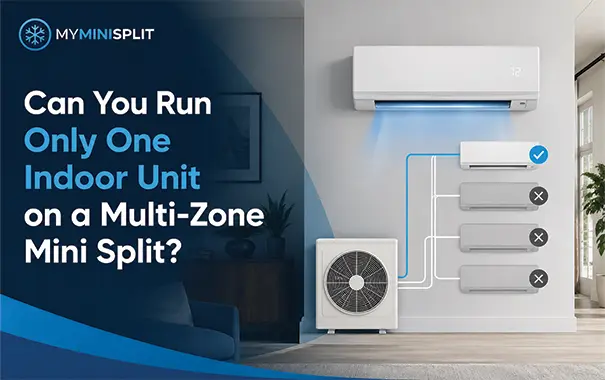
One of the main reasons homeowners choose a multi-zone mini split is the ability to control rooms separately. But that creates a common question: can you run only one indoor unit while the other connected heads remain off?
In most properly installed residential multi-zone systems, yes. You can normally turn on the indoor unit in the room you are using and leave the other connected indoor units off. The active head sends a demand signal to the shared outdoor condenser, which adjusts its output within the system’s operating range.
However, two different questions are often confused:
- Can one head in a fully installed multi-zone system operate while the others are off?
- Can a multi-zone outdoor condenser be installed with only one indoor head connected?
The answer to the first question is generally yes. The second depends entirely on the outdoor model’s approved combinations, minimum connected capacity, and installation requirements. This guide explains both situations and the important limits homeowners should understand.
Quick Answer
Yes, you can usually run one connected indoor unit on a multi-zone mini split while the other indoor units remain off. Each zone typically has its own controller, temperature sensor, fan, and demand signal.
The outdoor condenser will still operate because it supplies refrigerant and capacity to the active indoor unit. It should modulate downward to match that zone as closely as its compressor range allows.
This does not mean that any multi-zone condenser can be installed with only one indoor head. Some outdoor units require two or more connected heads, while others allow fewer than their maximum number only in specific combinations. Always verify the exact manufacturer combination table.
Operating One Head and Installing One Head Are Different
| Situation | Usually possible? | What must be checked? |
| Run one already-connected head while the other heads are off | Generally yes | Controller settings, compatible operating mode, minimum output, and model instructions |
| Turn all indoor heads off temporarily | Generally yes | Standby behavior, freeze-protection settings, schedules, and manufacturer guidance |
| Connect only one indoor head to a multi-zone condenser | Model-specific and often restricted | Minimum indoor-unit count, approved combinations, connected capacity, piping, commissioning, and warranty |
| Install four heads on a five-zone condenser | Sometimes | The exact four-head combination and connected-capacity range must be approved |
| Add another indoor head later | Sometimes | Available port, compatible model, piping, refrigerant charge, line limits, and recommissioning |
The most common homeowner use case is the first one: all required indoor units are installed, but only the occupied room is calling for cooling or heating. That is normal multi-zone operation.
How Independent Zone Control Works
A multi-zone system connects two or more indoor units to one outdoor condenser. Each indoor unit normally monitors the temperature in its own room and communicates its demand to the outdoor unit.
If only the bedroom head is on, that zone requests capacity. The living-room, office, and guest-room heads can remain off. If another room is turned on later, the outdoor condenser responds to the combined demand from both active zones.
Official Daikin multi-zone guidance explains that each indoor unit has its own thermostat and operates independently even though the indoor units share one outdoor unit. Mitsubishi Electric similarly describes multi-zone systems as providing distinct temperature setpoints and operating schedules for connected zones.
Independent control generally includes:
- Turning individual indoor units on or off
- Selecting a set temperature for each active room
- Adjusting fan speed or airflow direction by zone
- Using separate schedules where the controls support them
- Reducing conditioning in unused rooms
The outdoor condenser is shared, so independence is not unlimited. The indoor units still depend on the same compressor, available capacity, and system operating mode.
What Happens When Only One Indoor Unit Is Running?
When one indoor unit calls for cooling or heating, several things happen:
- The active head measures its room temperature and sends a demand signal.
- The outdoor unit starts or continues operating if capacity is required.
- The inverter compressor adjusts toward the load within its available range.
- Refrigerant is directed through the connected system to serve the active zone.
- The other indoor units remain off or in a non-conditioning state according to the system design.
If the active room reaches its setpoint, the compressor may slow down, pause, or cycle depending on the load and the unit’s minimum capacity. The exact behavior varies by model, outdoor temperature, fan settings, and control logic.
The outdoor unit does not deliver its full nameplate capacity to a small head simply because the other heads are off. Refrigerant flow, indoor-unit capacity limits, sensors, and system controls restrict the output available to that zone.
Can You Do This With a 2-Zone Mini Split?
Yes. In a typical installed dual-zone system, one indoor head can run while the second remains off. This is useful when a bedroom is occupied at night but the office or living space is not.
The indoor heads still need to be sized correctly. A small bedroom head operating alone may represent a much smaller load than the outdoor condenser’s nominal capacity. The condenser’s minimum modulation and the approved indoor-outdoor combination therefore matter.
If you are still selecting the equipment, use our two-zone mini split sizing guide to calculate both rooms separately and match the two heads to an approved condenser.
You can also browse the current 2-zone mini split systems after the room loads are known.
Can One Head Run Alone on a 3-, 4-, or 5-Zone System?
Generally, yes—provided all required indoor units have been installed correctly and the manufacturer permits normal individual zone control.
The same basic operating logic applies whether the outdoor unit serves two, three, four, or five heads. Only the active rooms request meaningful conditioning. The difference is that larger multi-zone condensers may have a higher minimum output, making their one-zone behavior especially important.
For example, one small bedroom calling on a five-zone condenser creates a much lighter load than five rooms calling together. A well-selected system should handle both conditions within its designed operating range, but it cannot modulate below its technical minimum.
Related planning guides include:
- Three-zone mini split sizing
- 4-zone vs 5-zone mini split comparison
- 3-zone mini split systems
- 4-zone mini split systems
- 5-zone mini split systems
Zone count should match the home’s actual control areas, not merely the maximum number of ports available on the condenser.
Does the Outdoor Condenser Run When Only One Head Is On?
Yes, when the active indoor unit needs heating or cooling, the shared outdoor condenser must operate. The indoor head cannot provide refrigeration-based cooling or heat-pump heating by itself.
The outdoor unit may run at reduced speed rather than at full output. Inverter-driven compressors are designed to vary capacity, but every model has a minimum and maximum operating range.
When the active room reaches its target temperature, the outdoor unit may reduce output or stop temporarily. Controls and electronics can remain powered in standby even when the compressor and indoor fans are not actively conditioning.
Why Minimum Compressor Output Matters
Minimum output is one of the most important—and most overlooked—details in a multi-zone design.
Suppose a large condenser serves four rooms, but only one small bedroom needs cooling overnight. If that room’s load is below the condenser’s minimum stable output, the system cannot continuously reduce capacity to the exact requirement.
Depending on the model and conditions, it may:
- Reach the setpoint quickly and cycle off
- Restart after the room warms again
- Produce wider temperature swings
- Spend less continuous time removing moisture
- Operate less efficiently than expected at that particular load
This does not mean running one zone is harmful. It means the equipment should be selected for both peak demand and low-load operation.
When comparing systems, ask for the minimum cooling and heating capacity of the exact outdoor unit and review how it performs with the smallest approved indoor head operating alone.
Will One Indoor Unit Receive the Condenser’s Full BTU Capacity?
No. A 9,000 BTU indoor unit does not normally become a 24,000, 36,000, or 42,000 BTU unit simply because it is the only active head.
The indoor coil, fan, refrigerant controls, piping, sensors, and manufacturer programming limit what that head can deliver. Its actual output may vary within a stated range, but the condenser’s entire nominal capacity is not automatically forced through it.
This is another reason not to oversize the outdoor unit with the assumption that one active room will receive all available BTUs. The complete matched combination and performance tables determine actual capacity.
Does Running One Zone Save Electricity?
Running one occupied zone will generally use less energy than actively conditioning every connected room under the same conditions. That is one of the practical benefits of zoning.
However, the savings are not calculated by simple division. Running one head on a four-zone system does not automatically use exactly one-quarter of the electricity.
Actual consumption depends on:
- The active room’s cooling or heating load
- Outdoor temperature and humidity
- The condenser’s minimum output
- Set temperature and fan settings
- Indoor and outdoor unit efficiency
- Line length and refrigerant charge
- How often the compressor cycles
- Standby power used by connected controls
- Heat transfer from neighboring unconditioned rooms
Turning off unused rooms can reduce demand, but allowing those rooms to become extremely hot or humid may increase heat and moisture transfer into the occupied areas. In Miami, unused zones may sometimes be better maintained at a moderate setback rather than left uncontrolled for long periods.
For more operating guidance, read Should You Leave Your Mini Split Running All Day?.
Should Unused Indoor Units Be Completely Off?
That depends on the room, season, humidity, and how long it will remain unused.
Turning an unused head off can make sense when:
- The room will be empty for several hours
- The door can remain closed
- The room has no moisture-sensitive contents
- Nearby conditioned spaces are not strongly affected
- The room does not contain pets, plants, electronics, or equipment needing temperature control
A moderate temperature setback may be more suitable when:
- The room is in a humid climate
- Moisture or mold risk is a concern
- The room contains sensitive furniture or electronics
- Heat from the room transfers into nearby occupied zones
- The space will be used again soon
Avoid setting one room extremely cold while allowing neighboring rooms to become very hot. The active head may work harder because heat continues moving through interior walls, floors, ceilings, and open doors.
Can One Zone Cool While Another Zone Heats?
Usually not on a standard residential multi-zone heat-pump system.
Although each indoor unit can have its own set temperature and on/off control, the connected heads commonly need compatible operating modes. If one indoor unit starts in cooling mode and another requests heating, the later unit may enter standby, flash a mode-conflict indication, or follow the mode that has priority.
The multi-zone cassette operation manual hosted by MyMiniSplit states that indoor units sharing one outdoor unit must use the same cooling or heating mode. A Mitsubishi Electric multi-system operation manual likewise explains that when one connected unit is cooling and another requests heating, the earlier operating mode takes priority for that system.
This does not prevent you from running only one head. It simply means that if another head is turned on, it generally needs to operate in a compatible mode.
Specialized heat-recovery systems can provide simultaneous heating and cooling, but that feature should not be assumed for a typical residential multi-zone mini split.
Why an “Off” Indoor Unit May Feel Warm or Make a Sound
An inactive head may occasionally make a refrigerant-flow sound or feel slightly warm during heating operation on some multi-zone systems. That does not necessarily mean the indoor unit is actively heating the room or that the system is defective.
Manufacturer operation guidance notes that refrigerant can continue flowing through parts of a connected multi-system even when a particular indoor unit is not operating. System equalization, valve position, defrost operation, and control logic can also create brief noises or temperature changes.
Normal sounds may include:
- Light hissing
- A flowing-water sound
- Expansion or contraction noises
- Brief valve or refrigerant movement sounds
Contact a qualified technician if the inactive unit blows significant conditioned air, shows an error code, leaks water, becomes unusually hot, produces loud or persistent noise, or does not respond to its controls.
Can All the Indoor Units Be Turned Off?
Generally, yes. If none of the indoor units requests heating or cooling, the compressor normally stops and the system enters standby.
Some electrical power may still be used for control boards, wireless receivers, crankcase heating, network modules, freeze protection, or other model-specific functions. Turning the indoor units off with their remotes is therefore different from disconnecting electrical power to the entire system.
Do not routinely switch off the system at the breaker as a substitute for using the controls. Power isolation may be appropriate for service, emergencies, or manufacturer-directed procedures, but normal daily operation should follow the supplied controller and manual.
Can You Install Only One Head on a Multi-Zone Condenser?
Do not assume that you can.
A multi-zone condenser may have two, three, four, or five connection ports, but the manufacturer defines the permitted number of connected indoor units and the approved capacity combinations. Some product families require at least two connected heads. Other outdoor units may permit fewer heads than their maximum port count, but only with listed indoor models and capacities.
Before connecting only one head—or leaving ports unused—verify:
- Minimum number of connected indoor units
- Maximum number of indoor units
- Approved indoor model and capacity
- Minimum and maximum connected BTUs
- Required treatment of unused ports
- Line-set diameter and length
- Refrigerant charge requirements
- Control and communication compatibility
- Commissioning procedure
- Warranty conditions
If your current and expected future need is only one room, a properly sized single-zone mini split is usually the more direct equipment choice.
Is a Multi-Zone System Efficient If You Usually Run One Room?
It can operate that way, but it may not be the best system architecture if one room accounts for nearly all use.
A single-zone system pairs one indoor unit with one outdoor unit selected specifically for that room. This can provide closer capacity matching and avoids asking a larger shared condenser to serve a very small load most of the time.
A multi-zone system becomes more valuable when:
- Multiple rooms regularly need conditioning
- Outdoor-unit space is limited
- Separate indoor temperature control is important
- The zones have different schedules
- The outdoor unit can modulate effectively across the expected load range
If one room operates daily while the others are rarely used, compare the proposed multi-zone system with separate single-zone units or a mixed layout. Review Single-Zone vs Multi-Zone Mini Split: Which Costs Less Over Time? before deciding.
Is It Bad for the System to Run Only One Head?
Normal one-zone operation is not inherently bad for a compatible, correctly installed multi-zone system. Independent control is part of the purpose of multi-zone equipment.
Concerns arise when:
- The outdoor unit is oversized for the active zone’s normal load
- The indoor-outdoor combination is not approved
- Too few indoor units were physically connected
- The system cycles excessively
- The active room has poor airflow or an oversized head
- Filters, coils, or drains are neglected
- Different active heads request conflicting modes
- Line lengths or refrigerant charge are incorrect
If the system maintains temperature, controls humidity acceptably, operates without error codes, and follows the manufacturer’s specifications, running one connected zone is typically a normal use case.
How to Use One Zone More Effectively
Close Doors to Genuinely Unused Rooms
This reduces direct air exchange, but remember that heat and moisture can still move through the building structure.
Use a Reasonable Set Temperature
Setting the active head extremely low will not make it cool faster beyond its operating capacity. It may increase runtime and create an uncomfortable temperature difference between rooms.
Use Schedules or Smart Controls
Turn on bedrooms before sleep, offices before work, and living areas before occupancy instead of conditioning every zone continuously.
Keep Every Indoor Unit Clean
An unused head still belongs to the installed refrigerant and drainage system. Clean filters and inspect coils, drains, and batteries according to the manufacturer’s schedule.
Watch Indoor Humidity
In Miami, a warm unused room can accumulate moisture. Use a moderate setback, dry mode where appropriate, or a dedicated humidity strategy based on actual measurements.
Check for Short Cycling
If the active head starts and stops frequently, overshoots the setpoint, or leaves the room clammy, ask a technician to review the load, minimum capacity, controls, refrigerant charge, and installation.
Common Mistakes to Avoid
Assuming “Independent” Means Completely Separate
Each head has individual controls, but the indoor units still share one outdoor compressor and usually one heating-or-cooling mode.
Believing One Head Receives All Outdoor BTUs
The indoor head and system controls limit the capacity delivered to one zone.
Buying a Large Condenser for Future Expansion Without Checking Today’s Combination
The current configuration must be approved and perform correctly even before a future head is added.
Leaving a Port Unused Without Following the Manual
Unused connections, minimum indoor-unit counts, and capacity ranges are model-specific installation matters.
Turning Every Unused Room Completely Off in a Humid Climate
This may reduce cooling demand, but uncontrolled humidity or heat transfer can create other problems.
Expecting Simultaneous Cooling and Heating
Most standard residential multi-zone heat pumps require compatible modes across active heads.
Ignoring Minimum Output
Peak BTUs are only half the sizing decision. The condenser also needs acceptable performance when one small zone is active.
Using Breaker Power as a Daily On/Off Control
Use the remote, thermostat, timer, or approved smart control for normal operation.
Single-Zone Operation Checklist
Before relying heavily on one head at a time, confirm that:
- All required indoor units are installed in an approved combination.
- Each indoor head is correctly sized for its room.
- The condenser’s minimum output suits the smallest zone.
- The active head can maintain temperature without excessive cycling.
- Humidity remains acceptable in the active and inactive rooms.
- Other heads are set to compatible modes before they are turned on.
- Schedules and smart controls do not restart an unwanted zone.
- Unused ports, if any, comply with the installation manual.
- Line lengths and refrigerant charge match manufacturer requirements.
- Filters, coils, and condensate drains are maintained.
- Any unusual noise, leakage, or error code is inspected.
Browse multi-zone mini split systems only after confirming the number of rooms, individual loads, and expected operating schedule.
The Bottom Line
Can you run only one indoor unit on a multi-zone mini split? In most fully installed systems, yes. You can turn on the head in the occupied room while the other connected indoor units remain off. The outdoor condenser will operate and modulate to serve the active zone within its available range.
What you should not assume is that a multi-zone condenser can be installed with only one connected head, that one small head receives the condenser’s full BTU capacity, or that different rooms can cool and heat simultaneously.
Check the exact approved combination, minimum compressor output, connected-capacity limits, and operating manual. If one room will account for nearly all system use, compare the multi-zone design with a properly sized single-zone system or separate smaller systems before purchasing.
Frequently Asked Questions
Can I Run One Mini Split Head and Turn the Others Off?
Yes. In most properly installed multi-zone systems, one connected indoor head can run while the other heads remain off. The active zone controls its own temperature and sends a demand signal to the shared outdoor condenser.
Does the Outdoor Unit Run When Only One Indoor Head Is On?
Yes. The outdoor condenser must operate whenever the active head needs refrigerant-based cooling or heat-pump heating. An inverter compressor may reduce its speed to match the smaller demand within its operating range.
Is It Harmful to Run Only One Zone on a Multi-Zone Mini Split?
No, normal one-zone operation is not inherently harmful when the equipment combination is approved and installed correctly. Problems can occur if the condenser cannot modulate low enough, the equipment is mismatched, or the system short cycles excessively.
Does One Indoor Head Receive All the Outdoor Unit’s BTUs?
No. The indoor coil, fan, refrigerant controls, and manufacturer programming limit the capacity available to one head. A small indoor unit does not receive the condenser’s full nominal output simply because the other zones are off.
Can One Mini Split Zone Cool While Another Heats?
Usually not on a standard residential multi-zone heat pump. Connected indoor units generally must use compatible modes. A unit requesting the opposite mode may enter standby or show a mode-conflict indication.
Do Indoor Units Use Electricity When They Are Turned Off?
They may use a small amount of standby electricity for controls, receivers, communications, or model-specific protective functions. That is different from the energy used during active cooling or heating.
Can I Install Only One Indoor Unit on a Multi-Zone Condenser?
Only if the manufacturer approves that exact one-head configuration. Some multi-zone condensers require at least two connected indoor units. Check the minimum unit count, connected capacity, unused-port instructions, and combination table.
Why Does an Indoor Unit Make Noise Even When It Is Off?
Some connected indoor units may produce brief refrigerant-flow, valve, expansion, or equalization sounds while another zone operates. This can be normal, but loud, persistent, or unusual noise should be inspected by a qualified technician.
Is It Cheaper to Run One Zone Instead of All the Zones?
It generally requires less energy than actively conditioning every connected room under the same conditions, but usage is not divided evenly by the number of heads. Actual savings depend on room load, weather, minimum compressor output, setpoints, and heat transfer from inactive rooms.