

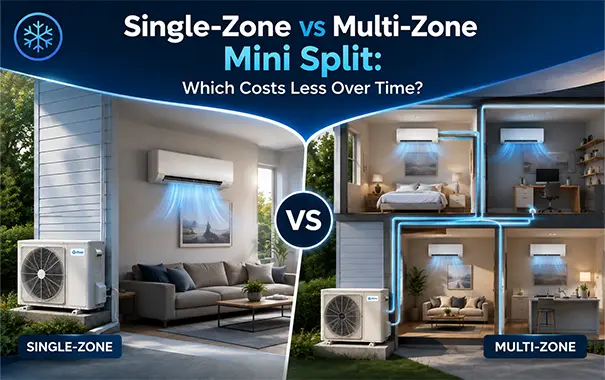
Choosing between a single-zone and multi-zone mini split is not only about how many rooms you want to cool. It is also a long-term financial decision involving equipment, installation, electricity, maintenance, repairs, and eventual replacement.
So, which one costs less over time?
For one room or one open area, a single-zone mini split is almost always the less expensive choice. For two or more rooms, a multi-zone system may cost less to install and maintain than several separate systems, but multiple high-efficiency single-zone units can sometimes produce lower operating costs and offer better repair flexibility.
The lowest-cost option depends on your floor plan, room loads, occupancy patterns, equipment ratings, installation complexity, and how long you expect to own the system.
Quick Comparison
| Cost factor | Single-zone system | Multi-zone system |
| Best application | One room or one open area | Multiple rooms or comfort zones |
| Initial equipment cost | Usually lower for one zone | Higher because of the larger condenser and multiple indoor units |
| Cost for several rooms | Requires multiple complete systems | May reduce duplicated outdoor equipment |
| Installation | Simpler for one system | More complex refrigerant and control design |
| Electricity use | Often strong model-specific efficiency | Can save through zoning, but performance depends on the matched combination |
| Maintenance | One indoor and one outdoor unit | Multiple indoor units but usually one outdoor unit |
| Repair impact | A failure affects one zone | An outdoor-unit failure may affect every connected zone |
| Replacement flexibility | Individual systems can be replaced separately | Indoor and outdoor compatibility can make future replacement more involved |
| Outdoor space | One condenser per zone | One condenser can serve multiple zones |
What Is a Single-Zone Mini Split?
A single-zone mini split has one outdoor condenser connected to one indoor air handler. It is designed to control the temperature in one room, one studio, one addition, or one open area.
You can browse single-zone mini split air conditioners in capacities ranging from compact bedroom systems to larger units for open living spaces.
A single-zone system normally includes:
- One outdoor condenser
- One indoor air handler
- One refrigerant line set
- One drain connection
- One electrical connection and disconnect
- One thermostat, remote, or controller
The one-to-one design is straightforward. If you need comfort in only one space, there is usually no financial reason to purchase a multi-zone condenser with unused connections.
What Is a Multi-Zone Mini Split?
A multi-zone mini split connects two or more indoor air handlers to one outdoor condenser. Each indoor unit serves a separate room or zone and can usually have its own temperature setting.
The multi-zone mini split collection includes systems designed for different numbers of indoor zones. For example, a 2-zone mini split can serve two rooms, while a 3-zone mini split can serve three.
A multi-zone design reduces the number of outdoor condensers, but it still requires an indoor unit, drain route, refrigerant piping, and controls for every zone.
The system must also be designed so the outdoor unit and all connected indoor units form an approved, properly sized combination.
Which Costs Less to Buy?
For one room, a single-zone system generally has the lower equipment cost. You are buying one complete cooling and heating system without paying for multi-zone capacity or additional ports you do not need.
For several rooms, the comparison changes. Installing a separate single-zone system in every room means purchasing multiple condensers and indoor units. A multi-zone system uses one larger outdoor unit and several indoor units, which can reduce duplicated equipment.
However, a multi-zone package is not automatically cheaper than several single-zone systems. Pricing depends on:
- The number of indoor zones
- The total required capacity
- Indoor unit styles, such as wall-mounted, cassette, floor-console, or concealed units
- Brand and efficiency tier
- Included line sets, wiring, controllers, and accessories
- Whether the selected components are sold as a complete matched system
Compare complete system packages rather than comparing the price of one outdoor unit with the price of one single-zone kit. A multi-zone quote must include every indoor unit and all required installation materials.
Which Costs Less to Install?
Single-zone installation cost
One single-zone system is usually simpler to install because it has one short refrigerant circuit, one indoor unit, one outdoor unit, and one control relationship.
Installing several separate single-zone systems multiplies many of those requirements. Each system may need its own outdoor mounting location, electrical disconnect, line-set route, wall penetration, condensate drain, and commissioning process.
Multi-zone installation cost
A multi-zone system can reduce the number of condensers, pads or wall brackets, and outdoor electrical connections. That can make it more cost-effective when exterior space is limited or several indoor units can be connected through practical line-set routes.
The tradeoff is design complexity. Longer refrigerant lines, branch connections, difficult access, concealed piping, condensate pumps, or indoor units spread across several floors can increase labor and materials.
Every connection must be installed and tested correctly, and the indoor-unit combination must fall within the manufacturer’s approved limits.
Get an itemized installation quote for both options. A lower equipment price can be erased by a difficult piping or electrical plan.
Which Uses Less Electricity?
Neither system type is always cheaper to operate. Electricity use depends on equipment efficiency, sizing, part-load performance, local weather, thermostat settings, and how the zones are used.
When a single-zone system may use less electricity
A single-zone model is optimized around one indoor unit and one outdoor unit. Some single-zone systems offer excellent SEER2 ratings and broad modulation ranges.
Separate single-zone systems can also be shut off independently. If a bedroom is used at night and a home office is used during the day, only the necessary system has to operate.
When a multi-zone system may use less electricity
A multi-zone system can condition several rooms without operating several outdoor condensers. Independent indoor controls allow you to reduce conditioning in unused zones instead of treating the entire home as one temperature zone.
That zoning advantage only creates savings when it is used. Leaving every indoor unit operating at an aggressive setting can eliminate much of the benefit.
Our guide on whether you should leave a mini split running all day explains how scheduling and zone control affect energy use.
Why the efficiency rating must match the exact system
Do not compare systems by brand name or total BTUs alone. Review the ratings for the complete matched combination you plan to install.
A multi-zone condenser may have different efficiency and capacity data depending on the indoor units connected to it. Also check the minimum operating capacity.
If only one small room calls for cooling, an oversized multi-zone condenser may not be able to reduce output as far as a dedicated small single-zone system.
For practical savings habits after installation, see these tips for reducing air-conditioning costs with a ductless mini split.
Maintenance Costs Over Time
A single-zone system has one indoor filter and coil, one drain, and one outdoor condenser to inspect and maintain.
A multi-zone system still has a filter, coil, blower, and drain at every indoor unit. This means a four-zone installation has four indoor units that need regular cleaning even though they share one condenser.
Compared with four separate single-zone systems, the multi-zone option usually has fewer outdoor coils, fans, electrical connections, and exterior components to maintain. That can reduce duplicated outdoor service work.
However, service access matters. A concealed indoor unit, ceiling cassette, long line run, or condensate pump may take more time to inspect than an easily accessible wall-mounted head.
System layout can affect maintenance cost as much as the words “single-zone” or “multi-zone.”
Repair Costs and the Risk of a Shared Condenser
Single-zone systems provide isolation. If one system develops a problem, the other independent systems can continue serving their rooms. You may also be able to repair or replace one zone without changing the others.
A multi-zone system has fewer outdoor units, but its condenser is shared. If that outdoor unit or a critical control component fails, every connected indoor zone may lose cooling or heating until the repair is completed.
This does not mean a multi-zone system is less reliable. It means the financial and comfort impact of one major failure may be larger.
In Miami, where air conditioning can be essential for much of the year, homeowners should consider whether system redundancy is worth the cost of additional outdoor equipment.
Coastal air, heavy rain, power surges, and hurricane exposure also belong in the ownership-cost calculation. Fewer outdoor condensers mean fewer exposed units to secure and protect, but a multi-zone condenser represents a larger share of the home’s cooling capacity.
Review our guide on protecting a mini split during hurricane season when planning equipment placement.
Replacement Costs and Future Flexibility
With multiple single-zone systems, each room has a separate equipment pair. If one system reaches the end of its useful service life earlier, it can usually be replaced without replacing the systems serving other rooms.
A multi-zone installation is more interconnected. Indoor and outdoor components must be compatible, and future products may not match older equipment.
Depending on the failure, model availability, refrigerant, and manufacturer requirements, replacing one major component can become more complicated.
On the other hand, one well-designed multi-zone condenser means fewer outdoor systems to replace over the ownership period.
There is no universal winner. Compatibility, parts availability, warranty coverage, and local service support should be evaluated before purchase.
Single-Zone vs Multi-Zone Costs in Common Situations
One bedroom, garage, or home office
Likely lower-cost option: Single-zone.
You need only one indoor unit, and a multi-zone condenser would add capacity and complexity without creating a useful second zone.
Two nearby rooms used on similar schedules
Likely lower-cost option: Often dual-zone, but compare quotes.
One outdoor condenser may reduce duplicated installation work. Two single-zone systems may still be attractive if they offer better model-specific efficiency, simpler refrigerant routes, or valuable redundancy.
Two rooms used at different times
Likely lower operating cost: Depends on part-load performance.
Both arrangements provide independent control. Compare how efficiently the multi-zone system operates with only one indoor unit calling against the performance of a dedicated single-zone system.
Three or more rooms with limited outdoor space
Likely more practical option: Multi-zone.
Using one condenser can avoid filling the exterior with multiple outdoor units. Installation complexity and line lengths still need to be evaluated.
Separate rental rooms or spaces where downtime matters
Likely more flexible option: Multiple single-zone systems.
Independent systems isolate usage and repairs. One failure does not remove comfort from every room connected to a shared condenser.
Do Not Confuse System Type With Correct Sizing
A poorly sized single-zone system can cost more to operate than a correctly sized multi-zone system, and a poorly designed multi-zone system can waste more energy than several correctly sized single-zone units.
Calculate the load for each room instead of dividing the total capacity evenly. Sun exposure, windows, insulation, ceiling height, occupancy, air leakage, and equipment all change the required capacity.
Start with the MyMiniSplit sizing calculator and read our guide to choosing the right mini split size.
A qualified HVAC professional should verify the final design with a room-by-room load calculation.
If you are comparing one large unit with several smaller systems, our detailed guide to one large mini split versus two smaller units covers the airflow and part-load questions in greater depth.
How to Compare the True Cost Before Buying
Ask each contractor or supplier to provide the following information for both options:
- Total equipment price, including every indoor and outdoor unit
- Installation labor and materials
- Electrical work and required disconnects
- Line-set lengths, branch components, and condensate solutions
- SEER2, EER2, and HSPF2 for the exact matched configuration
- Minimum and maximum capacity ranges
- Warranty terms and labor coverage
- Recommended maintenance schedule
- Expected repair access and local parts availability
- The cost and consequences of losing one outdoor unit
Then consider how you will actually use the rooms. A technically efficient system will not deliver the expected savings if unused zones are conditioned unnecessarily or the equipment is poorly sized.
The Bottom Line
For one room or one open area, a single-zone mini split normally costs less to buy, install, maintain, and replace.
For several rooms, a multi-zone mini split may cost less overall by reducing the number of outdoor condensers and duplicated installation components. It can be especially valuable when outdoor space is limited.
Multiple single-zone systems may still cost less over time when they provide better efficiency for the specific loads, allow phased installation, isolate repairs, or let individual systems be replaced independently.
The right comparison is not simply “one condenser versus several.” Compare complete installed prices, exact efficiency data, expected zone schedules, maintenance access, repair risk, and future replacement flexibility.
Frequently Asked Questions
Is a multi-zone mini split cheaper than separate single-zone units?
It can be cheaper for multiple rooms because one outdoor condenser serves several indoor units. However, complex refrigerant routing, branch components, and higher-capacity equipment can increase installation cost.
Compare complete, itemized quotes for both designs.
Are multi-zone mini splits more expensive to run?
Not automatically. A multi-zone system can save energy when you reduce conditioning in unused rooms.
Actual operating cost depends on the exact system’s efficiency, minimum capacity, weather, room loads, and how often several zones operate together.
Does every indoor unit in a multi-zone system need maintenance?
Yes. Every indoor unit has a filter, coil, blower, and drain that require inspection and cleaning.
The system normally has fewer outdoor units than several separate single-zone systems, but indoor maintenance still increases with the number of zones.
What happens if a multi-zone outdoor unit fails?
All indoor units connected to that condenser may lose heating or cooling until it is repaired. With separate single-zone systems, a failure normally affects only the room served by that system.
Can I install a multi-zone system and add indoor units later?
Only if the specific system supports the planned combination and the original installation was designed for future zones.
Outdoor capacity, available ports, piping, refrigerant requirements, and manufacturer-approved combinations must all be checked before assuming expansion is possible.
Which is better for a Miami home?
A single-zone system is usually best for one addition, garage, bedroom, or open area. Multi-zone systems can work well for several rooms and properties with limited exterior space.
Miami homeowners should also consider humidity control, salt-air exposure, storm protection, long cooling seasons, and the consequences of losing a shared condenser.