

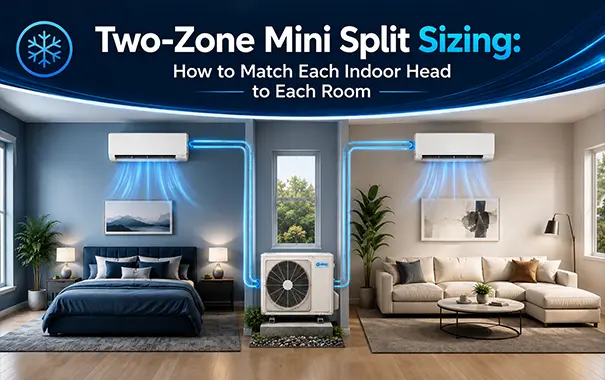
Sizing a two-zone mini split is not as simple as calculating the total square footage of two rooms and dividing the outdoor unit’s BTUs in half. Each room has its own cooling load, so each indoor head must be sized for the room it serves.
After sizing the rooms separately, you must select an outdoor condenser that supports the chosen indoor-head combination and can handle the expected simultaneous load.
The correct order is:
- Calculate the heating and cooling load of Room 1.
- Calculate the heating and cooling load of Room 2.
- Select an indoor head that matches each room.
- Verify that both heads are approved for the outdoor condenser.
- Confirm that the condenser can serve the two rooms under peak conditions.
Skipping any of these steps can create uneven temperatures, poor humidity control, unnecessary energy use, or inadequate capacity when both zones are operating.
Quick Answer
For two-zone mini split sizing, do not split the outdoor unit’s capacity evenly unless the two rooms genuinely have similar calculated loads.
A small shaded bedroom and a larger sunny office may need a 9,000 BTU head and a 12,000 BTU head rather than two identical units. Two similar bedrooms may be suited to a 9,000 + 9,000 BTU configuration. The final combination must appear in the manufacturer’s approved pairing data for the selected condenser.
You can compare common configurations in the 2-zone mini split collection.
What Does “Two-Zone” Mean?
A two-zone, or dual-zone, mini split connects two indoor air handlers to one outdoor condenser. Each indoor head conditions its own room and normally has a separate temperature setting and fan control.
The system therefore has three capacity decisions:
- The capacity of the indoor head in Room 1
- The capacity of the indoor head in Room 2
- The available capacity and approved loading range of the outdoor condenser
These ratings are related, but they are not interchangeable. The BTU number on the outdoor unit does not tell you how much capacity each room should receive.
If you are still deciding whether your layout needs one or two indoor heads, read Can One Mini Split Cool Two Rooms?. A larger single head may have enough total capacity but still fail to move air evenly through walls, doors, or hallways.
Step 1: Calculate Each Room’s Load Separately
Begin with two separate room calculations. Do not combine the square footage until each room’s individual load is understood.
Square footage is a useful starting point, but it is not the complete calculation. The load of each room can be affected by:
- Ceiling height
- Window size, type, and orientation
- Afternoon sun exposure
- Wall, ceiling, and floor insulation
- Air leakage
- Number of occupants
- Computers, televisions, and other electronics
- Cooking equipment or other heat-producing appliances
- Whether the room is above a garage or below a hot roof
- Local outdoor temperature and humidity
Two rooms with the same floor area can need different indoor-head capacities. A west-facing office with two computers and large windows may have a higher load than a shaded bedroom of the same size.
Use the MyMiniSplit sizing calculator for an initial estimate, then have a qualified HVAC professional verify the design with a room-by-room load calculation. Our guide to choosing the right mini split size also explains why both oversizing and undersizing cause problems.
Step 2: Match an Indoor Head to Each Room
Once you know the load of each room, choose the nearest appropriate indoor-unit capacity supported by the manufacturer.
The following ranges can help with early planning, but they are not a replacement for a professional load calculation:
| Room size | Common starting capacity | Important warning |
| Up to about 300 sq. ft. | 9,000 BTU | A very small, well-insulated room may need less than the head’s nominal rating |
| About 300–500 sq. ft. | 12,000 BTU | Sun exposure, windows, and room use can move the load up or down |
| About 500–750 sq. ft. | 18,000 BTU | Confirm that the selected two-zone condenser supports the combination |
| About 750–1,000 sq. ft. | 24,000 BTU | Large rooms require careful airflow and simultaneous-load planning |
For a broader explanation of these starting ranges, see How to Size a Ductless Mini Split Air Conditioner.
When 9,000 + 9,000 BTUs may work
This arrangement can suit two smaller rooms with similar loads, such as two comparable bedrooms. It should not be selected merely because 9,000 plus 9,000 equals an 18,000 BTU outdoor rating.
When 9,000 + 12,000 BTUs may work
This pairing is useful when one room has a lower load and the other is larger, sunnier, more occupied, or contains more heat-producing equipment.
MyMiniSplit carries an 18,000 BTU two-zone system with 9,000 and 12,000 BTU indoor units as one example of an approved unequal-room configuration.
When 12,000 + 12,000 BTUs may work
Two medium-sized rooms with similar calculated loads may suit identical 12,000 BTU heads. The selected outdoor unit must still list 12,000 + 12,000 as an approved combination and provide acceptable performance when both rooms call at once.
When two very different head sizes may work
Some approved systems support combinations such as 12,000 + 24,000 BTUs for a small room paired with a much larger open area. This requires more careful design because the two zones have very different loads and the outdoor unit must distribute capacity between them.
Step 3: Match the Indoor Heads to the Outdoor Condenser
After choosing the indoor heads, verify the outdoor unit. This is where two-zone sizing becomes different from selecting two independent single-zone systems.
Check the manufacturer’s engineering data for:
- Approved indoor-unit model combinations
- Minimum and maximum connected capacity
- Rated and maximum outdoor capacity
- Capacity available at your design temperature
- Performance when one zone operates alone
- Performance when both zones operate together
- Refrigerant line-length and elevation limits
- Certified SEER2, EER2, and HSPF2 for the exact combination
Do not assume that any two indoor units from the same brand can connect to any outdoor condenser from that brand. Product series, control protocols, refrigerant requirements, and approved model numbers must match.
Browse the broader multi-zone mini split collection only after identifying the indoor capacities your rooms need.
Should Indoor-Head BTUs Equal the Outdoor Unit’s BTUs?
Not always. Some manufacturers allow the nominal capacities of the connected indoor units to total more than the outdoor unit’s nominal rating. This is sometimes called connected-capacity diversity.
For example, a manufacturer may approve two indoor heads whose nominal ratings total more than the condenser’s rated output because both rooms do not always require their full capacity simultaneously.
However, approved does not mean unlimited. When both zones demand maximum output, the outdoor unit cannot provide more than its available capacity under those conditions. Capacity may be shared between the indoor units.
This is especially important in Miami and other hot-humid climates, where two sun-exposed rooms may reach peak load at the same time.
Do not apply a connected-capacity percentage from one brand or product family to another. Use the combination table and performance data for the exact system being installed.
An Illustrative Two-Room Example
Imagine a homeowner wants to condition two separate rooms:
- Room 1: A smaller shaded bedroom with a professionally calculated cooling load that fits a 9,000 BTU indoor head
- Room 2: A larger home office with afternoon sun, two computers, and a calculated load that fits a 12,000 BTU indoor head
The correct indoor selection would likely be 9,000 + 12,000 BTUs—not two 9,000 BTU heads and not two 12,000 BTU heads.
The next step is to find a two-zone condenser that explicitly supports those indoor models and provides adequate capacity when both rooms are occupied during a hot afternoon. The outdoor unit should not be chosen from the 21,000 BTU indoor total alone.
This example is illustrative. Actual room loads and approved equipment combinations must be calculated and verified for the property.
Why Oversizing One Indoor Head Causes Problems
It is tempting to install the larger available head “just to be safe,” but an oversized indoor unit can create several problems:
- It may satisfy the room temperature too quickly.
- The room may receive short bursts of strong airflow.
- Humidity control may suffer.
- The head may spend more time near its minimum output.
- The occupant may experience temperature swings or drafts.
- You may pay more for capacity the room cannot use.
In a multi-zone system, an oversized head may also distort how the outdoor condenser responds to calls from the two rooms. Inverter operation helps equipment modulate, but it does not make sizing irrelevant.
Why Undersizing One Indoor Head Causes Problems
An undersized head may run continuously and still fail to maintain the set temperature during peak weather. That room can remain warmer or more humid than the other zone, even when the total outdoor capacity appears sufficient.
This is why each head must match its own room. Extra capacity available at the condenser cannot fully correct poor indoor-unit selection, placement, or airflow.
Indoor-Head Placement Matters Too
Even a correctly sized head can perform poorly if it is installed in the wrong location.
For each room, the indoor unit should have:
- A clear path for supply air
- Adequate return-air clearance
- A location that does not blow directly onto a bed, desk, or seating area
- Access for filter cleaning and service
- A practical condensate-drain route
- A line-set route that remains within manufacturer limits
Avoid installing the head where a wall, tall cabinet, curtain, or doorway immediately blocks the airflow. The sensor should also represent the room’s normal occupied conditions rather than a concentrated heat source.
Special Sizing Considerations for Miami Homes
Miami’s long cooling season and high humidity make room-by-room sizing especially important.
Pay close attention to:
- West- and south-facing glass
- Rooms directly below the roof
- Older windows and air leakage
- Poorly insulated additions
- Enclosed patios or converted garages
- Home offices with several electronics
- Kitchens or rooms connected to cooking areas
- Rooms with different daytime occupancy schedules
Do not automatically oversize both heads because the climate is hot. A professional load calculation should already use appropriate local design conditions.
The goal is enough capacity for peak conditions without sacrificing steady operation and moisture removal during normal conditions.
Common Two-Zone Sizing Mistakes
Mistake 1: Dividing the condenser capacity equally
An 18,000 BTU outdoor unit does not automatically mean each room needs a 9,000 BTU head. The rooms decide the head sizes; the approved combination determines the condenser.
Mistake 2: Using combined square footage only
Combined square footage hides differences in windows, sunlight, insulation, occupancy, and room use.
Mistake 3: Assuming more BTUs are safer
Oversizing can harm comfort and humidity control. Bigger is not automatically better.
Mistake 4: Ignoring simultaneous peak demand
If both rooms receive strong afternoon sun or are occupied together, both may require substantial capacity at the same time.
Mistake 5: Mixing unapproved equipment
Indoor heads and outdoor units must be compatible by exact model and approved combination—not only by brand or nominal BTU rating.
Mistake 6: Ignoring minimum output
Check how the condenser operates when only the smaller room calls for conditioning. A system designed around peak total load must also perform acceptably at low load.
Mistake 7: Treating placement as an afterthought
Capacity cannot compensate for blocked airflow, a poor sensor location, or an impractical condensate route.
Two-Zone Sizing Checklist
Before purchasing a system, confirm all of the following:
- Each room has a separate cooling and heating load estimate.
- The load considers windows, sun, insulation, ceilings, occupants, and equipment.
- Each indoor head is selected for the room it serves.
- The head styles and exact model numbers are compatible with the condenser.
- The indoor combination appears in the manufacturer’s approved data.
- The connected capacity falls within the permitted range.
- The condenser can handle expected simultaneous demand.
- One-zone and two-zone performance have been reviewed.
- Line lengths, elevation, drainage, and electrical requirements are acceptable.
- The final design has been verified by a qualified HVAC professional.
If you are comparing a dual-zone system with two independent systems, read One Large Mini Split vs Two Smaller Units and Single-Zone vs Multi-Zone Mini Split: Which Costs Less Over Time? before making the final decision.
The Bottom Line
Correct two-zone mini split sizing begins with the rooms—not the outdoor condenser.
Calculate Room 1 and Room 2 separately, choose an indoor head that matches each calculated load, and then select an outdoor unit that supports the exact combination and expected simultaneous demand.
Two similar rooms may need equal heads, while rooms with different sizes, sun exposure, or usage may need an unequal pairing such as 9,000 + 12,000 BTUs. Never assume a combination is acceptable until it is confirmed in the manufacturer’s technical data.
Explore available two-zone mini split systems after calculating both room loads, and have the final selection verified by a qualified installer.
Frequently Asked Questions
Do both indoor heads in a two-zone mini split need the same BTU rating?
No. The heads should be sized for their individual rooms. Two similar rooms may use equal heads, while rooms with different loads may need an unequal combination such as 9,000 + 12,000 BTUs.
Can I connect a 9,000 BTU head and a 12,000 BTU head to an 18,000 BTU condenser?
Only if the manufacturer lists the exact indoor models and the 9,000 + 12,000 combination as approved for that condenser. Do not rely only on the BTU numbers or brand name.
Does the outdoor condenser need to equal the combined indoor BTUs?
Not always. Some manufacturers permit connected indoor capacity above the outdoor unit’s nominal rating. The permitted range and resulting performance are model-specific, and capacity may be shared when both rooms call at full load.
What happens if one indoor head is too large for its room?
The room may cool quickly but experience drafts, temperature swings, or weaker humidity control. The unit may also operate near its minimum capacity more often, reducing the benefit of proper inverter modulation.
Can both indoor heads run at the same time?
Yes. Both heads can normally operate simultaneously, but they share the outdoor unit’s available capacity. If their combined demand exceeds what the condenser can provide under current conditions, capacity will be distributed between the zones.
Is square footage enough to size each indoor head?
No. Square footage is only a starting point. Windows, sun exposure, insulation, ceiling height, air leakage, occupancy, electronics, room use, and local design conditions must also be considered.