

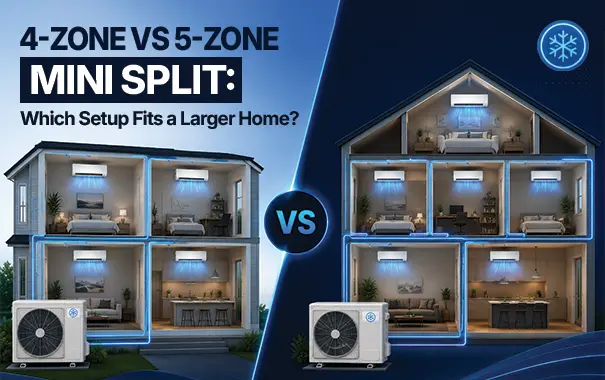
Choosing between a 4-zone and 5-zone mini split may look simple: count the rooms and buy a system with the same number of indoor heads. In a larger home, however, the correct choice depends on much more than whether you have four or five doors to close.
Each room has its own heating and cooling load. The outdoor condenser must support the exact indoor-unit combination, deliver enough capacity when several zones call at once, and operate efficiently when only one small zone needs conditioning. Line-set routes, condensate drainage, electrical requirements, indoor-unit placement, service access, and the consequences of relying on one outdoor unit also affect the decision.
A 5-zone system is not automatically more powerful or more efficient than a 4-zone system. It simply provides a connection and control strategy for an additional indoor zone. In some larger homes, that fifth zone is valuable. In others, a properly sized 4-zone system—or two smaller systems—provides a better result.
Quick Answer
Choose a 4-zone mini split when four distinct spaces genuinely need independent temperature control and the selected condenser can support their calculated loads. Choose a 5-zone mini split when a fifth enclosed room also needs its own indoor unit, the exact five-head combination is approved, and the outdoor unit has enough usable capacity for the zones likely to run together.
Do not choose the 5-zone option only because the home is large or because you may add a room someday. An unused port, a future indoor unit, or a connected-capacity increase must be permitted by the exact manufacturer and model.
For a home with distant wings, separate floors, heavy simultaneous loads, or a strong need for backup cooling, two smaller systems may be more practical than placing four or five important rooms on one condenser.
4-Zone vs 5-Zone Mini Split at a Glance
| Factor | 4-zone mini split | 5-zone mini split |
| Indoor zones | Up to four compatible indoor units | Up to five compatible indoor units |
| Best fit | Four rooms or control areas with separate loads | Five rooms or control areas that each need independent control |
| Equipment and installation | Usually fewer heads, circuits, drains, and wall penetrations | Usually more equipment, labor, piping, drainage, and controls |
| Outdoor-unit demand | Must cover realistic simultaneous demand from four zones | Must cover realistic simultaneous demand from five zones |
| Low-load operation | Must modulate well when one small zone runs | Especially important because the condenser may be larger relative to one small zone |
| Reliability exposure | One outdoor failure can affect four zones | One outdoor failure can affect five zones |
| Future flexibility | Appropriate when only four zones are needed | Useful only when the fifth zone is real and the combination is approved |
| Alternative worth comparing | A 3-zone system plus one single-zone unit | Two systems such as 3+2 or 4+1 |
The number of zones is only one selection criterion. Capacity, compatibility, efficiency, and building layout can be more important.
What Counts as a Mini Split Zone?
A zone is an independently controlled indoor unit or control area—not automatically an entire floor, bedroom count, or equal share of the home’s square footage.
In a typical ductless multi-zone system, each indoor head serves the room where it is installed. Conditioned air does not reliably move through closed doors, around corners, or down long hallways. One wall-mounted head may condition an open living and dining area because the spaces share air freely, but it should not be assumed to cool several enclosed bedrooms.
That distinction matters when counting zones in a larger home. Consider the spaces that need direct air delivery and independent control:
- Bedrooms that are normally closed at night
- Home offices with computers or irregular schedules
- Open living, dining, or kitchen areas
- A media room with a high internal heat load
- A converted garage, addition, or guest suite
- Upper-floor rooms exposed to roof heat
If four indoor units can provide proper airflow to every served space, a 5-zone system does not add value by itself. If five enclosed rooms need separate conditioning, trying to force four heads to cover them can create uneven temperatures.
For projects involving three rooms, start with our three-zone mini split sizing guide. The same room-by-room principle applies as the zone count increases.
Begin With Room-by-Room Load Calculations
The decision should begin with a load calculation for every proposed zone. Do not combine the entire home’s square footage, divide it by four or five, and assign equal heads.
Each room calculation should account for:
- Floor area and ceiling height
- Window area, glass performance, and orientation
- Direct solar exposure
- Wall, roof, floor, and ceiling insulation
- Air leakage and exterior-door use
- Whether the room is above a garage or below a hot roof
- Typical occupants
- Lighting, computers, televisions, and other equipment
- Cooking or moisture-producing activities
- Desired indoor temperature
- Local outdoor design conditions
- Sensible and latent cooling requirements
ACCA describes Manual J as the ANSI-recognized residential load-calculation standard. After the loads are established, Manual S provides a process for selecting equipment using the load and manufacturer performance data.
The MyMiniSplit sizing calculator can provide an initial estimate. Before ordering a four- or five-zone system, have a qualified HVAC professional complete or verify a room-by-room calculation and the final equipment match.
When a 4-Zone Mini Split Is the Better Fit
A 4-zone mini split is usually the stronger choice when four indoor units serve all the spaces that genuinely need direct conditioning.
Common examples include:
- Three bedrooms plus one open living area
- Two bedrooms, one office, and one living room
- Four similar bedrooms
- Two upstairs rooms and two downstairs rooms with practical piping routes
- A main home plus a nearby enclosed addition, provided all four loads fit the system
Choosing four zones instead of five can reduce the number of indoor units to purchase, mount, clean, and service. It also eliminates one refrigerant circuit, one condensate route, one controller, and potentially one difficult wall penetration.
Fewer zones do not necessarily mean lower total capacity. A four-zone system can use larger indoor heads when the rooms require them. For example, MyMiniSplit currently lists a 42,000 BTU four-zone cassette package with four 12,000 BTU indoor units. That configuration has a different purpose from a five-zone package using five smaller heads.
Review the available 4-zone mini split systems only after identifying the four room loads and preferred indoor-unit types.
When a 5-Zone Mini Split Makes More Sense
A 5-zone mini split is appropriate when five distinct spaces need their own indoor units and controls. The fifth zone should solve a real comfort or airflow problem, not merely provide a higher number on the equipment list.
A five-zone layout may suit:
- Four bedrooms plus one living area
- Three bedrooms, an office, and an open family area
- Two bedrooms, two offices, and one common space
- A larger home with five occupied rooms on similar schedules
- A property where exterior space or community rules make one outdoor condenser preferable
The benefit is independent control in an additional room while retaining a single outdoor unit. The tradeoff is greater system complexity and a larger group of rooms dependent on the same condenser.
MyMiniSplit lists a 42,000 BTU five-zone package with five 9,000 BTU indoor units. This can be a useful shopping example for five smaller-load zones, but five 9,000 BTU heads should not be selected merely because there are five rooms. Each room must support that indoor-unit size, and the complete combination must suit the home’s simultaneous load.
You can compare the current 5-zone mini split collection after the five zone requirements are known.
Real 4-Zone and 5-Zone Configuration Examples
The current MyMiniSplit catalog illustrates why zone count and condenser BTUs should not be treated as the same thing.
Four 9,000 BTU Heads With a 36,000 BTU Outdoor Unit
The listed 36,000 BTU four-zone system with 9,000 + 9,000 + 9,000 + 9,000 BTU indoor units provides four equal wall-mounted zones. Equal heads make sense only when the four room loads support them.
Four 12,000 BTU Heads With a 42,000 BTU Outdoor Unit
The listed 42,000 BTU quad-zone cassette system pairs four nominal 12,000 BTU cassette units with a 42,000 BTU condenser. The indoor ratings total 48,000 BTUs, showing why approved connected capacity can differ from the outdoor unit’s nominal rating.
Five 9,000 BTU Heads With a 42,000 BTU Outdoor Unit
The listed 42,000 BTU five-zone wall-mounted system uses five nominal 9,000 BTU indoor units, totaling 45,000 connected indoor BTUs.
These examples do not show that one arrangement is universally better. They show that a 42,000 BTU outdoor rating can appear with different zone counts, indoor totals, indoor-unit types, and room applications. Use the exact model numbers, combination tables, submittal data, and performance tables—not the zone label alone.
Outdoor Capacity and Connected Indoor Capacity Are Different
Adding the nominal ratings of the indoor heads gives the connected indoor capacity. It does not guarantee that the outdoor condenser can deliver that entire total at one moment.
In a multi-zone system, active indoor heads share the outdoor unit’s available capacity. When the combined demand is within the condenser’s output, the system can modulate to meet it. If four or five zones request more than the condenser can provide under the current outdoor conditions, the available output is distributed among them.
Manufacturers may approve a connected indoor total above the condenser’s nominal rating because rooms do not always peak at the same time. However, an allowed connection ratio is not proof that the arrangement fits every home. The building’s realistic simultaneous load must still be checked.
For example, five bedrooms used mainly at night may have a different demand pattern from five west-facing offices occupied during the same afternoon. Both layouts have five zones, but the second may place a much heavier concurrent load on the condenser.
Confirm all of the following for the exact proposed system:
- Maximum number of connected indoor units
- Minimum number of indoor units required
- Approved indoor model numbers and types
- Permitted connected-capacity range
- Cooling and heating output at design conditions
- Capacity allocation with multiple active zones
- Minimum and maximum compressor output
- Per-zone and total line-set limits
- Required refrigerant adjustments
- AHRI-rated combination and efficiency data
Never transfer a connected-capacity percentage or combination rule from another model, product family, or manufacturer.
Is a 5-Zone Mini Split More Efficient Than a 4-Zone System?
Not automatically. Zone count alone does not determine operating efficiency.
A 5-zone system may reduce wasted conditioning when five rooms have different schedules and occupants turn back unused zones. A 4-zone system may be more efficient when only four indoor units are necessary and adding a fifth head would oversize a small room or encourage unnecessary cooling.
Compare efficiency using the exact matched combination, not a general brand claim. Review:
- SEER2 and EER2 for cooling
- HSPF2 for heating where relevant
- AHRI certificate or manufacturer-rated combination
- Minimum and maximum capacity
- Power input at part and full load
- Performance at local outdoor conditions
- Expected zone schedules and simultaneous demand
- Line length and installation quality
A high published SEER2 value cannot compensate for poor sizing, incorrect refrigerant charge, obstructed airflow, or an unapproved indoor-outdoor match.
Daikin’s official multi-zone overview shows that one outdoor unit can serve multiple independently controlled rooms, including systems supporting up to five zones. The exact efficiency and available combinations remain product-specific.
Why Minimum Output Matters More as the System Gets Larger
Homeowners often focus on peak capacity, but a larger multi-zone condenser must also handle very small loads.
Imagine a five-zone system sized for several rooms, but only one small bedroom calls for cooling overnight. The condenser needs to reduce its output enough to serve that zone steadily. If its minimum output is high relative to the active room’s load, the system may cycle, drift around the setpoint, or provide less consistent humidity control.
This issue can occur with either zone count, but it deserves extra attention as the condenser and connected capacity grow. Review the exact system’s minimum operating capacity and its behavior with only the smallest permitted indoor unit active.
Do not assume that inverter technology can modulate without limit. Every compressor has a minimum operating range.
Installation Complexity: Four Circuits vs Five
Adding a fifth zone usually means more than mounting one extra indoor head. It can require:
- Another refrigerant line-set route
- Another condensate drain or pump
- Another communication and power circuit between components
- Another wall or ceiling penetration
- More line-hide or concealed routing
- Additional refrigerant depending on line length
- More commissioning and leak-testing work
- More access for future filter cleaning and service
In a large home, distance can be the deciding factor. A fifth room may be far from the condenser, on another floor, or across a finished section where piping is difficult to conceal. The total route may exceed the outdoor unit’s maximum combined line length even if each individual circuit seems acceptable.
Before choosing the condenser location, map all four or five circuits. Check:
- Individual line length
- Total combined line length
- Vertical separation
- Bend and access limitations
- Condensate drainage slope
- Exterior appearance
- Service clearances
- Hurricane-rated mounting and local requirements where applicable
- Electrical disconnect, breaker, and conductor requirements
A five-zone system with poor routes can cost more and be harder to service than two well-placed smaller systems.
Wall-Mounted Heads vs Ceiling Cassettes
The four-zone and five-zone decision can also change with indoor-unit type.
Wall-mounted heads are often easier to access and may allow gravity drainage when positioned on an exterior wall. Ceiling cassettes distribute air in several directions and can suit larger or more open rooms, but they need suitable ceiling space, service access, and carefully planned condensate removal.
Do not compare a four-zone cassette package and a five-zone wall-mounted package only by price or total BTUs. They create different installation requirements and airflow patterns.
Some manufacturers permit mixed indoor-unit types on one condenser, but the exact wall, cassette, floor, or concealed-ducted models must appear in the approved combination data.
Cost Differences Beyond the Equipment Price
A 5-zone system usually costs more to install than a comparable 4-zone system because it adds an indoor unit and another circuit. The final difference can be small or substantial depending on the home.
Budget for:
- Outdoor condenser and indoor units
- Line sets, insulation, and line-hide
- Condensate drains or pumps
- Wall brackets, pads, or mounting hardware
- Electrical panel capacity and circuit work
- Core drilling and wall or ceiling repair
- Refrigerant adjustments for longer lines
- Labor for evacuation, testing, and commissioning
- Permit and inspection requirements
- Long-term filter, coil, pump, and drain maintenance
The fifth zone may be financially sensible if it replaces a separate system and has a short, accessible line route. It may be poor value if the room rarely needs conditioning or requires an exceptionally difficult installation.
Compare complete installed proposals, not only online equipment prices. Confirm that each proposal includes the same scope, line lengths, electrical work, drainage solution, permits, and commissioning.
Comfort and Humidity in a Larger Miami Home
Miami’s long cooling season and high moisture load make correct sizing especially important. More BTUs do not automatically create better comfort.
An oversized indoor head may cool its room quickly but provide short bursts of operation, drafts, temperature swings, or weaker moisture removal. An undersized head may run continuously without maintaining the setpoint during peak heat.
At the outdoor-unit level, assumed load diversity should be realistic. Bedrooms may peak at night while living spaces peak earlier, which can reduce concurrent demand. Conversely, several west-facing rooms or occupied home offices may call heavily at the same time.
For either a 4-zone or 5-zone system:
- Size every head for its room’s sensible and latent load.
- Check realistic simultaneous demand.
- Review minimum output for low-load periods.
- Place indoor units for good air circulation.
- Keep doors and expected room use in the design assumptions.
- Plan reliable condensate drainage.
- Do not use a very low thermostat setting as a substitute for humidity design.
Reliability: One Condenser Means One Shared Dependency
One multi-zone condenser reduces the number of outdoor units, but it also creates a shared point of failure.
If a 4-zone condenser is unavailable, all four connected rooms may lose heating or cooling. With a 5-zone system, five rooms can be affected. This does not mean multi-zone equipment is unreliable; it means the impact of one service event is larger.
Two smaller systems can provide partial backup. If one outdoor unit needs service, the other can continue conditioning its zones. This can be valuable in Miami, in homes with elderly occupants, or where a home office, nursery, server equipment, or medical need makes uninterrupted cooling important.
The tradeoff is duplicated outdoor equipment, electrical connections, maintenance, and exterior space. Reliability should be evaluated alongside first cost and aesthetics.
One 5-Zone System vs a 4-Zone System Plus a Single-Zone Unit
If four rooms are close together and the fifth is remote, a 4-zone system plus one single-zone mini split may be more practical than one five-zone condenser.
The split approach can offer:
- Shorter and simpler refrigerant routes
- Independent backup for the fifth room
- Better matching for a room with an unusually large or small load
- Separate operating schedules
- Easier future replacement of one part of the home’s system
One 5-zone system can offer:
- One outdoor condenser instead of two
- A cleaner exterior where outdoor space is limited
- One coordinated equipment family
- Potentially fewer electrical and mounting locations
Neither architecture is automatically cheaper or more efficient. Compare the exact equipment, installed scope, rated combinations, part-load performance, and service consequences.
Our guide to single-zone vs multi-zone mini split costs explains the broader long-term tradeoffs.
One Large Multi-Zone System vs Two Smaller Multi-Zone Systems
A large home does not have to place every room on one condenser. Common alternatives include:
- One 3-zone system plus one 2-zone system
- Two 2-zone systems for four rooms
- One 4-zone system plus one single-zone unit
- Separate systems for upstairs and downstairs
- Separate systems for the main house and an addition
Two systems may be preferable when the zones are far apart, have very different schedules, or regularly peak at the same time. Dividing the load can also reduce the number of rooms affected by one equipment failure.
One shared system may be preferable when exterior space is limited, line routes are compact, the rooms have useful load diversity, and the approved condenser performs well at both low and high demand.
For more context on equipment architecture, read One Large Mini Split vs Two Smaller Units.
Can You Buy a 5-Zone Condenser and Use Only Four Heads?
Possibly, but only when the exact outdoor model permits a four-indoor-unit combination. “Five-zone” often describes the maximum number of connections, not blanket permission to install any number of heads.
Before planning future expansion, verify:
- The minimum and maximum number of connected indoor units
- Whether the proposed four-head combination is listed
- Whether unused ports require specific treatment
- Whether the connected BTU total is within the permitted range
- Whether the initial line and electrical design can support a later fifth zone
- Whether adding a head later affects refrigerant charge, commissioning, efficiency, or warranty
Do not install an oversized 5-zone condenser merely to reserve a future port unless the current four-zone configuration also performs correctly at minimum and peak loads.
Decision Examples for Larger Homes
Example 1: Three Bedrooms and One Open Living Area
Four indoor units may be enough: one for each bedroom and one for the connected living area. A fifth zone adds little unless another enclosed space needs direct conditioning.
Likely direction: Properly sized 4-zone system.
Example 2: Four Bedrooms and One Open Family Area
Each closed bedroom needs direct airflow, and the family area needs its own unit. If the five room loads and simultaneous demand match an approved system, five zones may be logical.
Likely direction: 5-zone system, subject to load and combination verification.
Example 3: Four Nearby Rooms Plus a Detached or Distant Office
Running a fifth circuit across the property may be difficult, and the office may need independent operation during the day.
Likely direction: 4-zone system plus a single-zone system for the office.
Example 4: Upstairs Bedrooms and Downstairs Living Spaces
The two floors may have different peak times, piping routes, and service needs. Dividing the home into two systems may simplify installation and provide redundancy.
Likely direction: Compare one 5-zone system with a 3+2 arrangement.
Example 5: Five Rooms With Small Calculated Loads
Five rooms do not automatically justify five 9,000 BTU heads. If one or more rooms have loads well below the indoor units’ suitable operating range, the design may need another indoor-unit type, a compact ducted solution, or a different zoning strategy.
Likely direction: Revisit indoor-unit selection and system architecture before buying.
Common 4-Zone vs 5-Zone Selection Mistakes
Counting Rooms Without Checking Airflow
An open kitchen, dining, and living space may function as one zone, while two closed bedrooms normally should not.
Dividing Condenser BTUs Equally
The outdoor rating is not a pool that should automatically be divided into four or five identical shares. Each room determines its indoor-unit requirement.
Assuming Five Zones Mean More Total Capacity
A 5-zone condenser can have the same nominal capacity as a 4-zone condenser. Zone count describes connectivity, not guaranteed output.
Selecting Equal Heads for Unequal Rooms
Equal 9,000 or 12,000 BTU heads are appropriate only when the separate loads support them.
Ignoring Simultaneous Demand
An approved connected-capacity ratio may still perform poorly in a home where all zones regularly peak together.
Ignoring Minimum Capacity
The system must operate acceptably when only the smallest room calls, not just when every zone is active.
Planning an Unverified Future Fifth Zone
An available-looking port does not prove that a future indoor unit can be added in any size or model.
Comparing Equipment Prices Instead of Installed Prices
Line length, drainage, electrical work, access, and finish repairs can change the real cost substantially.
Overlooking the Shared-Failure Risk
One condenser is visually convenient, but one outage can affect all connected zones.
Treating Product-Category Labels as Engineering Approval
Compatibility must come from exact model documentation and approved combination data, not only a store category or a similar product name.
4-Zone vs 5-Zone Mini Split Checklist
Before ordering, confirm that:
- Every served room has a separate heating and cooling load calculation.
- The home truly needs four or five independently controlled indoor zones.
- Each indoor head matches its room’s load and airflow needs.
- The indoor-unit types and model numbers are compatible with the condenser.
- The exact indoor combination is approved.
- Connected capacity falls within the manufacturer’s permitted range.
- Outdoor capacity is adequate for realistic simultaneous demand.
- Minimum output suits periods when only one small zone operates.
- The exact combination’s SEER2, EER2, HSPF2, and AHRI data have been reviewed.
- Every individual and total line length stays within limits.
- Elevation, refrigerant adjustment, drainage, and service access are acceptable.
- The electrical panel, circuit, disconnect, and mounting plan are suitable.
- The cost comparison includes the complete installed scope.
- The consequences of one outdoor-unit failure are acceptable.
- A two-system alternative has been considered for distant rooms or separate floors.
- A qualified HVAC professional has verified the final design.
Browse the full multi-zone mini split collection once the room loads and preferred system architecture are clear.
The Bottom Line
In the 4-zone vs 5-zone mini split decision, the better system is the one that matches the home’s actual control areas, room-by-room loads, simultaneous demand, installation routes, and service priorities.
Choose four zones when four indoor units can deliver direct, properly sized conditioning to all required spaces. Choose five zones when a fifth enclosed room genuinely needs independent control and the complete five-head combination performs correctly at both peak and minimum loads.
For a spread-out home, separate floors, or rooms with very different schedules, compare one large system with two smaller systems before purchasing. The extra outdoor unit may add cost and exterior equipment, but it can simplify piping, improve load matching, and preserve partial cooling during service.
Start with room loads, then select indoor heads, then choose the compatible outdoor equipment. Zone count should be the result of the design—not the shortcut used to create it.
Frequently Asked Questions
Is a 5-Zone Mini Split Better Than a 4-Zone System for a Large House?
Not automatically. A 5-zone system is better only when five spaces need independent indoor units and the approved equipment can meet their loads. If four heads cover the required spaces, a properly sized 4-zone system may cost less and be simpler to install and maintain.
Can All Four or Five Mini Split Zones Run at the Same Time?
Yes, the connected indoor units can normally operate simultaneously, but they share the outdoor condenser’s available capacity. If their combined demand exceeds the outdoor unit’s output under current conditions, capacity is distributed among the active zones.
Does a 5-Zone Mini Split Use More Electricity Than a 4-Zone System?
Not simply because it has another zone. Energy use depends on the exact equipment, room loads, setpoints, weather, operating schedules, and installation. Conditioning a fifth room can increase total consumption, while independent control may reduce waste in rooms that are turned back when unused.
What Size Condenser Do I Need for Four or Five Indoor Heads?
Calculate every room’s load, select the indoor units, and then choose an outdoor condenser that approves the exact combination and can meet realistic simultaneous demand. Do not size the condenser by zone count or by adding square footage alone.
Can I Connect Four Heads to a 5-Zone Condenser and Add Another Later?
Only if the exact outdoor model permits the initial four-head combination and a later five-head combination. Minimum connected units, indoor models, connected capacity, unused-port requirements, line lengths, and refrigerant adjustments must all be verified.
Is One 5-Zone System Better Than a 3-Zone Plus a 2-Zone System?
One 5-zone system uses fewer outdoor units and may suit a compact layout. A 3+2 arrangement can provide shorter piping, better separation of loads, and partial backup if one condenser needs service. The better option depends on layout, load timing, installed cost, and reliability priorities.
Can One Indoor Head Serve Two Rooms in a 4-Zone System?
It may serve connected open areas with good air movement, but it should not be expected to condition two normally closed rooms evenly. Enclosed rooms that need dependable temperature control usually require separate indoor units or a properly designed ducted solution.
Are Five 9,000 BTU Heads Suitable for Any Five-Bedroom Home?
No. Each bedroom needs its own load calculation. Some rooms may require less or more capacity, and the exact five-head combination must be compatible with the outdoor unit. Equal room counts do not guarantee equal loads.