

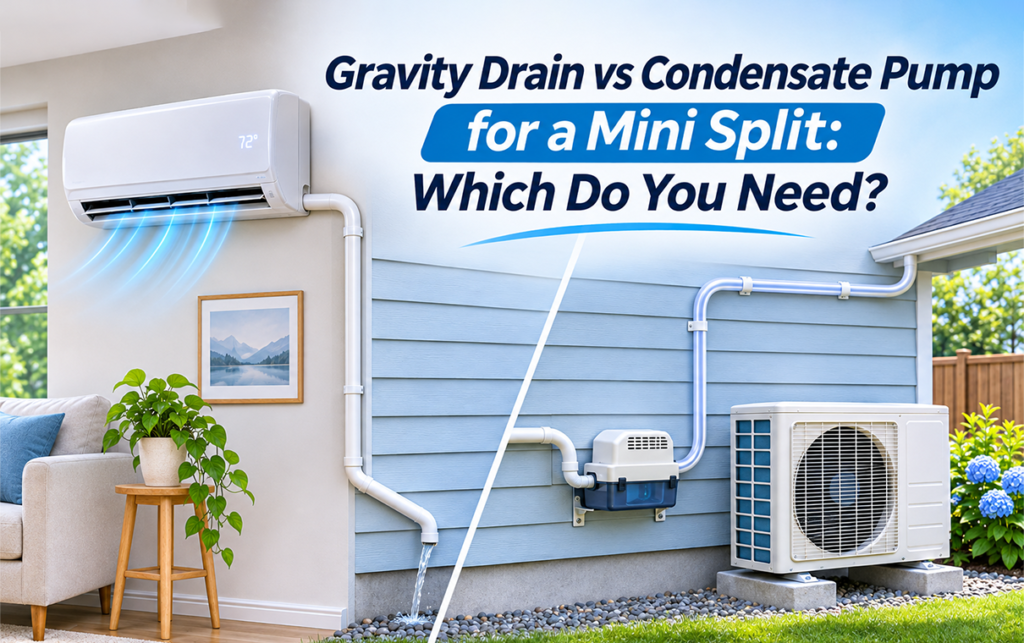
Use a gravity drain when water can flow downhill from the indoor unit to an approved discharge point along the entire route. Choose a condensate pump when the route requires water to rise or a practical gravity path is unavailable. If the indoor unit already includes a lift pump, check its limits before buying an additional one.
Gravity drainage usually means fewer components to buy and maintain. A pump can make an interior-wall installation possible, but it adds electrical connections, operating noise, and maintenance. Decide where the water will go before choosing the indoor unit’s final location.
Gravity drain vs condensate pump at a glance
| What to compare | Gravity drain | Condensate pump |
| How it moves water | Water flows downhill through a sloped drain | A powered pump moves water through discharge tubing |
| When it fits | A continuous downhill route reaches an approved outlet | Water must rise or the layout prevents practical gravity drainage |
| Extra power | No drain motor to power | Requires a compatible electrical supply |
| Sound | No pump motor noise | Can produce an intermittent hum or vibration |
| Maintenance | Inspect and clean the pan, drain, and outlet | Also service the reservoir, sensor, pump, and associated tubing |
| Common problems | Clogs, sags, disconnected hoses, or poor slope | Those drainage issues plus pump, sensor, or power problems |
| Cost considerations | Often simpler when the route is accessible | Adds equipment, wiring, protection, and future servicing |
Neither choice guarantees trouble-free drainage. The complete route, installation quality, and access for cleaning determine how well it works.
Why does a mini split need a drain?
During cooling, moisture from room air condenses on the cold indoor coil. A pan collects that water and directs it into the condensate drain.
The drain carries water separately from the copper refrigerant pipes. Those copper pipes may travel upward to an outdoor condenser, while an ordinary gravity drain needs a downhill route. The drain does not have to follow the refrigerant line all the way to the outdoor unit.
Indoor condensate drainage during cooling is also separate from any water produced at the outdoor unit during heating or defrost.
When a gravity drain is the better fit
Gravity works well when the indoor unit sits above an approved outlet and the route can maintain the specified fall without sags or uphill sections. A wall-mounted head on an exterior wall often offers that opportunity.
An interior-wall head can also drain by gravity if the building provides a suitable sloped route. The wall’s location alone does not decide whether you need a pump.
How much slope does a mini split drain need?
Use the equipment instructions and applicable local requirements. For the wall-mounted systems covered by its guide, Pioneer specifies a downward gradient of at least 1/100. The installer should confirm the slope required for your equipment and address before planning the route. Pioneer wall-mounted drain guidance
Hypothetical planning example. At a 1% slope, a 20-foot horizontal run needs 2.4 inches of fall. That calculation assumes the entire horizontal section follows that slope. Connections, required drain components, and the available height at the outlet still need checking.
A destination lower than the indoor unit can be unsuitable if the pipe must rise over a beam along the way.
What should the installer check?
Ask the installer to verify the drain connection size, pipe support, required traps or check valves, insulation, cleaning access, and outlet location. Have them test drainage before covering the route.
When an extension is needed, match the actual connection and required drain size. Our 10-foot condensate drain hose extension is one available accessory. Confirm its suitability for your equipment and complete drain design before buying.
When you need a condensate pump
A pump may be appropriate when the drain must rise into a ceiling space, cross a route without enough available fall, or reach an approved destination above the indoor drain outlet.
Before adding one, ask whether a different head location or drain route would allow gravity drainage while preserving comfortable airflow and service access. Compare the installed scope for each option.
The indoor unit still needs to drain into the pump
Many small mini split pumps use a separate reservoir that receives water from the indoor unit. The pump then moves that water through smaller discharge tubing.
The section feeding the reservoir must work as the pump manufacturer specifies. Installing a pump farther along the route will not correct a sag or uphill section that prevents water from reaching its reservoir.
Choose by flow at the required lift
Pump selection involves more than the mini split’s BTU rating. Your installer should check expected condensate volume, vertical lift, tubing length and diameter, bends, suction limits where applicable, and the pump’s permitted operating duty.
For example, Aspen’s US Mini White FP1058/RS sheet lists a maximum flow of 3.2 US gallons per hour at zero head, with 1 US gallon per hour at its 33-foot maximum recommended head. That illustrates why maximum flow and maximum lift cannot be treated as simultaneous operating figures. Confirm the exact pump version and its performance curve. Aspen Mini White US technical sheet
Ask how the pump will be mounted, reached for cleaning, and replaced later. In a bedroom, discuss where any intermittent sound or vibration could be heard.
Does a ceiling cassette already have a pump?
Some ceiling cassettes include a condensate lift pump. Its permitted rise, starting point for that measurement, and downstream drain arrangement depend on the model.
A built-in pump may lift water a limited distance before it enters a sloped drain. Check the complete installation diagram before assuming it can carry water across an attic or up to a roof.
Our ceiling cassette vs wall-mounted mini split guide explains the other ceiling-space and service-access differences to consider.
What if the pump fails or the drain blocks?
Ask your installer to specify and test compatible overflow protection for the equipment and layout. Depending on the design, that may include a high-water device that stops cooling, an alarm, or other required protection.
A pump having a safety contact does not establish that the contact has been connected to the mini split correctly. Have the installer demonstrate the intended response during commissioning.
If water is already leaking indoors, stop cooling and arrange service. Our mini split water-leak guide covers related causes, including clogs and ice buildup. If shutdowns coincide with a pump alarm, the mini split short-cycling guide explains why a drainage-related shutdown needs a separate check.
For routine care, follow the equipment and pump manuals. Ask how often the reservoir, sensor, filter, and drain should be inspected under your operating conditions, and which cleaning products are approved.
Where can a mini split drain in Miami or South Florida?
Choose an approved destination before choosing the drainage method. A pump can move water to a higher point, but the discharge location still needs approval.
Miami-Dade’s mechanical inspection checklist addresses nuisance discharge and checks drain components, water-level protection, and insulation. Have the contractor confirm the applicable requirements for your address and installation. Miami-Dade mechanical inspection guidance
For a condo, ask management to approve the route and destination. A balcony edge, neighboring property, or nearby plumbing connection should not be assumed suitable. Our Miami condo mini split guide covers drainage approval and building access in more detail.
What should your installation quote include?
Ask for a quote that identifies the discharge destination and shows the complete route. For gravity drainage, it should account for the available fall, required piping, insulation, and cleaning access.
For a pumped installation, request the pump model, performance at the proposed lift, electrical work, overflow protection, and service location. Include drainage and safety-function testing in the handover.
If both layouts are practical, compare the full installed cost and ongoing servicing needs. That gives you a clearer basis for choosing than the pump’s purchase price alone.
Frequently asked questions
Does every mini split need a condensate pump?
No. A suitable gravity route can carry condensate from the indoor unit to an approved discharge point. Some indoor units include a pump, so check the exact model and drain layout before buying one separately.
Can a gravity drain run uphill for a short distance?
An ordinary gravity drain needs the specified downhill route. An uphill section can hold water and cause backup. Have the installer change the route or design a suitable pumped arrangement.
Can a condensate pump run after the mini split stops?
Yes. Water can continue draining from the coil and pan after cooling stops, so the pump may run briefly to empty its reservoir. Persistent running, new noise, alarms, or indoor leaks should be checked.
Will a condensate pump make my mini split cool better?
A pump removes water when the route requires it. It does not increase the mini split’s rated cooling capacity. Correct drainage helps the system operate without drainage-related leaks or shutdowns.
Is a condensate pump maintenance-free?
No. Follow the pump manual for inspecting and cleaning its reservoir, sensor or float, filter, tubing, and other serviceable parts. Keep access available and ask the installer to explain the maintenance schedule.