

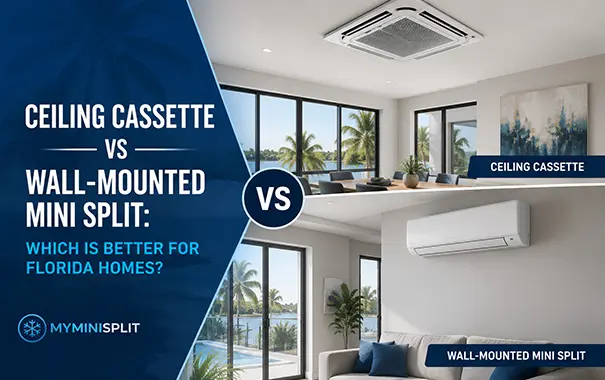
For most Florida bedrooms, home offices, and straightforward retrofits, a wall-mounted mini split is the practical choice. For a larger open living area with suitable ceiling space, a ceiling cassette may distribute air more evenly while keeping the walls clear. Neither style controls humidity better simply because of where it mounts. Correct sizing, steady operation, drainage, and installation determine how comfortable the room feels.
That is the short answer. The right choice for your home depends on the shape of the room, the space available for installation, and how you plan to use it. A cassette that looks perfect in a renovation can become difficult to service if its drain and access were overlooked. A wall unit that is easy to install can leave part of a wide room warm if its airflow cannot reach that area.
Here is how to compare the two before you choose a system.
Ceiling cassette vs wall-mounted mini split at a glance
| Factor | Wall-mounted mini split | Ceiling cassette mini split |
| Where it sits | High on a wall | Recessed into a suitable ceiling; the grille remains visible |
| Airflow | Directed across the room with adjustable louvers | Spread from the ceiling; the pattern depends on whether the model is one-way, four-way, or another design |
| Often suits | Bedrooms, offices, additions, and simpler retrofits | Open living areas and rooms with limited usable wall space |
| Installation planning | Suitable wall, clear airflow, line-set route, and condensate drain | Ceiling structure and depth, support, line-set route, service access, and condensate removal |
| Filter access | Usually reached from the front of the unit | Accessed from the ceiling grille |
| Appearance | Indoor unit remains visible | Most of the indoor unit is concealed |
| Typical project cost | Often lower for a comparable installation | Often higher because ceiling and drainage work can add labor |
These are planning differences, not promises about a particular product. Compare the installation manuals and performance data for the exact systems you are considering.
How does each indoor unit cool a room?
A wall-mounted mini split hangs high on a suitable wall. It draws in room air and sends conditioned air outward through adjustable louvers. In a bedroom or office, a good position can carry air along an open path without blowing directly onto the bed or desk.
A ceiling cassette places most of the indoor unit above the finished ceiling. Its visible grille sends conditioned air into the room. Many cassettes use a four-way pattern, which can work well near the center of an open area. Other models discharge in fewer directions, so do not assume every cassette covers a room in the same way.
Both are indoor units connected to an outdoor condenser. Both need a clear return-air path, a way to remove condensation, and enough service access. If you are comparing product styles, browse the wall-mounted mini split collection and ceiling cassette collection as starting points. Your room’s load and the manufacturer’s installation requirements should guide the final selection.
Which one is better for a Florida living room?
A ceiling cassette is often worth considering for a broad, open living room if it can be placed where its airflow reaches the occupied areas. It keeps wall space available for windows, shelves, or artwork. A suitable four-way model may send air across an open living and dining area from one central point.
The key word is open. A cassette cannot push cooling through a closed bedroom door simply because it has several outlets. Beams, high light fixtures, and the shape of the room can also interrupt its airflow.
A wall-mounted unit can still work well in a living room. If the space has a long, clear air path and a suitable mounting wall, its directed airflow may be exactly what the layout needs. In an L-shaped room or one with a narrow connected area, neither a central cassette nor one large wall head should be chosen from square footage alone. The installer must check where supply air travels and where room air returns.
If you hope one indoor unit will serve several spaces, read Can One Mini Split Cool Two Rooms?. Open connected areas and enclosed rooms call for different plans.
Which one is better for a bedroom or home office?
A wall-mounted unit is usually easier to justify in a smaller, enclosed room. The installation normally avoids opening a large section of ceiling, and the filter is easier to reach for routine cleaning.
Placement still matters. A head aimed straight at a bed can create an uncomfortable draft. A unit above a tall cabinet may struggle to move air across the room. Before choosing the mounting spot, check the manufacturer’s clearances and picture where the air will travel when the door is closed.
A ceiling cassette may suit a bedroom when wall space is scarce or appearance is a priority. It still needs an appropriate ceiling cavity, structural support, a drain route, and comfortable airflow at the bed. Ask how the filter and internal components will be reached after the ceiling is finished.
For an office with computers, afternoon sun, or large windows, do not assume it needs the same capacity as a bedroom of equal size. The room-by-room load matters more than the room label.
Florida humidity: Does a cassette remove more moisture?
No indoor-unit style has an automatic humidity advantage. Moisture removal depends on the selected equipment, its capacity and controls, how long it operates, the amount of humid air entering the home, and the condition of its drain system.
An oversized system can bring the temperature down quickly yet leave the room feeling clammy. This is especially relevant when choosing a mini split for a shaded bedroom or a well-insulated addition. Buying more BTUs “just in case” can work against comfort.
Have a qualified HVAC professional calculate the room’s cooling load, including its moisture load, before selecting capacity. Windows, sun exposure, insulation, air leaks, occupants, and appliances all affect that result. Our mini split sizing calculator can help with an early estimate; it does not replace a room-by-room professional calculation.
Some mini splits have a dry or dehumidification mode. Its behavior varies by model and conditions. It should not be treated as a fix for water intrusion, excessive outdoor-air leakage, or an equipment sizing problem. If you want to understand that setting, see what dry mode does on a mini split.
Can your ceiling support a cassette?
This question can settle the decision before you compare product features.
A recessed cassette needs enough usable space for the specific model, along with a support method approved by its manufacturer. The installer must account for joists or trusses, insulation, electrical wiring, plumbing, lights, and any equipment already above the ceiling. Ceiling height alone does not tell you whether a cassette will fit.
The unit also needs a suitable opening and room to remove its grille, filter, and serviceable parts. An accessible attic may make inspection easier, but it does not automatically provide the right location or drain route. If a structural member is in the way, do not plan to cut it to make the unit fit; have the installation assessed properly.
A wall-mounted head needs its own checks: a suitable wall, manufacturer-required clearances, a clear discharge path, and a practical route for refrigerant lines, wiring, and condensate. It may be the simpler choice in an existing home with a finished or crowded ceiling.
Condensate drainage matters in both designs
Florida air conditioning produces condensation. That water needs a dependable path away from the indoor unit.
A wall-mounted head may be able to drain by gravity when its position and routing allow it. A ceiling cassette may have a built-in lift pump or need a model-specific drainage arrangement. Do not assume a pump is required for every cassette or included with every product.
For either style, ask the installer to show where the condensate goes and how the line can be inspected and cleaned. For a cassette, ask how a blockage or pump fault will be detected before water damages the finished ceiling. The final design should follow the equipment instructions and applicable local requirements.
Drain access is part of the ownership cost. The most attractive location is a poor choice if a technician cannot reach the drain pan or pump later.
Is a ceiling cassette more efficient than a wall-mounted unit?
You cannot determine efficiency from mounting style alone. Compare the published ratings and performance of the complete, approved indoor and outdoor combination. A cassette and wall head can have different ratings even when their nominal BTU labels look alike.
The room layout also affects comfort. A correctly placed unit may let you maintain a comfortable setting without overcooling the area nearest the grille. That is an airflow benefit, not proof that every cassette uses less electricity than every wall unit.
Ask your installer to compare:
- The room’s calculated cooling and moisture loads.
- The exact indoor and outdoor model numbers.
- Published efficiency and capacity data for the matched system.
- Minimum capacity when the room needs only a little cooling.
- Airflow at the seating or sleeping area.
- Condensate routing and access for cleaning.
Those details tell you more than a broad claim that one indoor style is “more efficient.”
What will each option cost to install and maintain?
A wall-mounted installation is often less expensive when both styles can serve the same room well. A cassette can add ceiling work, support, longer routing, drainage work, and finishing. The price difference depends on the home, the model, and what is above the ceiling, so a national price range cannot replace an itemized local quote.
Ask contractors to price the complete job: equipment, electrical work, mounting, refrigerant lines, condensate solution, any ceiling repair, commissioning, and access panels. Compare the same scope between quotes.
Maintenance differs too. A wall unit’s filter is commonly reached from the front. A cassette filter is reached overhead through its grille. Either style needs cleaning according to its manual, and each indoor unit has a coil and drain that need attention. If your home will have several zones, our guide to single-zone versus multi-zone costs explains why the number of indoor units also affects long-term upkeep.
What about a Florida coastal home or hurricane exposure?
The cassette-versus-wall decision concerns the indoor unit. Both styles connect to outdoor equipment that needs a suitable location and installation.
For a coastal property, discuss exposure, corrosion protection, maintenance, and the manufacturer’s requirements for the outdoor unit. Its mounting and placement also need to account for the property’s storm and flood conditions. These considerations do not make a cassette or wall head the automatic winner indoors. They are part of the full system design.
Our guide to protecting a mini split during hurricane season covers outdoor-unit planning in more detail.
Can you use a cassette in the living room and wall units in the bedrooms?
Sometimes, yes. Certain multi-zone systems support different indoor styles on one compatible outdoor condenser. That can be a useful plan for a Florida home: a cassette in an open common area and wall units in enclosed bedrooms.
Do not choose the heads separately and assume they will connect. The manufacturer must approve the exact indoor model numbers and capacities with the selected outdoor unit. The installer also needs to check simultaneous cooling demand, minimum output when only one room runs, line-set limits, controls, and drainage for every zone.
See our guide to mixing wall-mounted, cassette, floor, and concealed indoor units before building a mixed-style system. For a three-room layout, the three-zone mini split sizing guide walks through the room-by-room capacity checks.
A practical room-by-room decision guide
Choose a wall-mounted mini split when:
- The room is a bedroom, office, or enclosed addition with a clear airflow path.
- The ceiling is finished, shallow, crowded, or difficult to access.
- Easy filter access matters to you.
- A suitable wall and a practical drain route are available.
- You want to keep installation work and cost more straightforward.
Consider a ceiling cassette when:
- The room is a larger, genuinely open area.
- Wall space is limited or a visible wall unit would disrupt the layout.
- The selected model’s discharge pattern suits the room shape.
- A professional confirms the ceiling can house and support the unit.
- Drainage and future service access can be designed properly.
Pause before choosing either one when the room is L-shaped, divided by doors, unusually sunny, or persistently humid. Those conditions deserve a closer look at load, airflow, and moisture sources. A different head location, more than one zone, or another indoor-unit style may serve the space better.
Questions to ask before you order
Bring these questions to an installer rather than selecting a unit from a square-footage chart:
- What are this room’s calculated cooling and moisture loads?
- Where will conditioned air travel, and what could block it?
- Is there enough room to install and later service the indoor unit?
- How will condensate leave the unit, and what happens if the drain stops?
- Which exact indoor and outdoor models form an approved combination?
- How does the system run during lighter cooling demand?
- What work is included in the written installation quote?
Start with the ceiling cassette systems or wall-mounted systems that fit your preferred layout. Then use the model documentation and an installer’s room assessment to narrow the choice. If you need help finding a suitable setup, contact My Mini Split with your room dimensions, photos, and location.
Frequently asked questions
Is a ceiling cassette better than a wall-mounted mini split in Florida?
A cassette may be better for an open area with suitable ceiling space and a well-planned drain. A wall-mounted unit is often the simpler fit for a bedroom, office, or retrofit. Both must be sized and installed for the room’s cooling and moisture needs.
Does a ceiling cassette cool an entire house?
Usually not by itself. It can serve an appropriately sized open zone, but walls and closed doors restrict airflow to other rooms. A larger home may need several indoor zones or another distribution design.
Do ceiling cassette mini splits need an attic?
They need an installation space and support arrangement that meet the selected model’s requirements. An accessible attic can help, but it is not the only possible construction arrangement and does not guarantee that the unit will fit.
Does a ceiling cassette need a condensate pump?
It depends on the model and the drain route. Some cassettes include a lift pump; other installations may use a different approved drainage arrangement. Confirm the exact equipment and the complete drain design before ordering.
Are wall-mounted mini splits easier to maintain?
Their filters are usually easier for a homeowner to reach. Ceiling cassette filters require overhead access. Both styles still need regular filter care and professional attention to the coil, blower, and condensate system as appropriate.
Can a wall unit and a ceiling cassette share one condenser?
Yes, if the manufacturer approves those exact indoor models with the chosen multi-zone outdoor unit. Matching the brand or adding up the BTU labels is not enough to establish compatibility.