

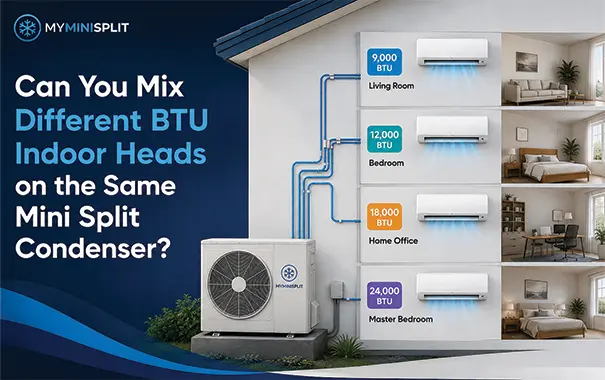
Yes, you can mix different BTU indoor heads on the same multi-zone mini split condenser—but only when the manufacturer approves the exact combination. A 9,000 BTU head and a 12,000 BTU head may work on one outdoor unit, while the same numbers from another brand, series, or refrigerant platform may not.
The safe rule is simple: size each room first, then verify the exact indoor model numbers in the condenser’s approved combination table. Do not connect heads just because they share a brand name or because their BTUs add up to the outdoor unit’s rating.
Quick answer
Different-size indoor heads are often useful because rooms rarely have identical loads. A small bedroom may need 9,000 BTUs while a sunny office needs 12,000 BTUs. A larger living area may need 18,000 BTUs while two bedrooms each use 9,000 BTUs.
Possible combinations include:
- 9,000 + 12,000 BTUs for two rooms with different loads
- 9,000 + 9,000 + 12,000 BTUs for two small rooms and one medium room
- 9,000 + 9,000 + 18,000 BTUs for two bedrooms and a larger living area
- 12,000 + 12,000 + 12,000 BTUs for three rooms with similar loads
These are examples, not universal recommendations. The exact indoor models, outdoor model, refrigerant, control protocol, connected-capacity range, line-set limits, and performance data must all match.
One current Pioneer triple-zone listing shows why the combination table matters. It identifies approved two-unit and three-unit capacity combinations, lists compatible indoor models by capacity and style, and directs buyers to a matching table before configuring the system. Pioneer also notes that the outdoor unit regulates total output based on the demand from the connected indoor units. See the Pioneer Quantum Ultra triple-zone specifications for an example of model-specific documentation.
What does “mixing BTUs” mean?
In this context, mixing BTUs means connecting indoor heads with different nominal capacities to one multi-zone outdoor condenser. The heads may be wall-mounted, ceiling cassette, concealed ducted, or another supported style. Each head serves its own zone and responds to that room’s demand.
Mixing capacity is different from mixing incompatible equipment. You cannot assume that any 9,000 BTU indoor unit can connect to any 12,000 BTU or 18,000 BTU outdoor system. The indoor unit must use the correct refrigerant, electronics, communication protocol, expansion device, and connection method for the condenser.
A single-zone condenser is also not a multi-zone condenser. It normally serves one indoor unit and should not be split into multiple heads unless the manufacturer specifically designed it for that purpose.
Why would you want unequal indoor heads?
Unequal heads let the system follow the home’s actual room loads instead of forcing every space into the same BTU size.
Consider a two-room installation:
- Bedroom: 220 square feet, shaded, low occupancy
- Home office: 360 square feet, west-facing windows, computer equipment
The bedroom may suit a 9,000 BTU head while the office may need 12,000 BTUs. Installing two 12,000 BTU heads could oversize the bedroom. Installing two 9,000 BTU heads could leave the office short during the afternoon.
An unequal combination can also reduce unnecessary capacity in rooms that are used less often. It does not make the outdoor condenser deliver the sum of every indoor nameplate rating at all times. The outdoor inverter still distributes available capacity according to current demand.
For more background, read our two-zone mini split sizing guide before choosing a 9,000 + 12,000 BTU arrangement.
Step 1: Calculate each room’s load separately
Do not start by dividing the outdoor condenser’s BTUs between the rooms. Start with separate heating and cooling loads.
Room load can be affected by:
- Floor area and ceiling height
- Window size, glass type, orientation, and shading
- Direct morning or afternoon sun
- Wall, ceiling, roof, and floor insulation
- Air leakage around doors and windows
- A room above a garage or below a hot roof
- Number of occupants
- Computers, televisions, lighting, and appliances
- Cooking or other internal heat sources
- Humidity and local outdoor design conditions
- How the room is used and when it reaches peak demand
ACCA describes Manual J as the ANSI-recognized standard for residential HVAC load calculations. Manual S uses those loads, local conditions, and manufacturer performance data to guide equipment selection.
The MyMiniSplit calculator can provide an initial estimate. A qualified HVAC professional should verify the final room-by-room loads before ordering equipment.
Step 2: Choose each indoor head for its room
Once the loads are estimated, choose the closest supported indoor capacity for each space. The head should be large enough for the room’s design load without being oversized simply to provide a safety margin.
As a preliminary planning guide only:
| Room or load pattern | Common starting capacity | Important caution |
| Small bedroom or office | 9,000 BTU | Sun, occupancy, and insulation may change the result |
| Medium bedroom or office | 12,000 BTU | Verify glass area and equipment heat |
| Larger living area | 18,000 BTU | Room shape and air distribution matter |
| Very large or open space | 24,000 BTU or more | Use a detailed load and placement plan |
These ranges are not a substitute for a Manual J calculation. A 9,000 BTU head may be wrong for a highly exposed 250-square-foot room and excessive for a very efficient 350-square-foot room.
If you need help with the room-level decision, use How to Choose the Right Mini Split Size for Your Room.
Step 3: Add the nominal indoor capacities
After selecting the heads, add their nominal ratings to get the connected indoor capacity.
Examples:
- 9,000 + 12,000 = 21,000 BTUs
- 9,000 + 9,000 + 12,000 = 30,000 BTUs
- 9,000 + 9,000 + 18,000 = 36,000 BTUs
- 12,000 + 12,000 + 12,000 = 36,000 BTUs
You can also calculate a screening ratio:
Connected-capacity ratio = total indoor nameplate BTUs ÷ outdoor nominal BTUs × 100
For example, 9,000 + 12,000 connected to an 18,000 BTU condenser produces a nominal ratio of 116.7%. That arithmetic does not prove the combination is allowed. It only shows what must be checked against the manufacturer’s engineering data.
Some product families allow connected indoor capacity above the outdoor unit’s nominal rating because room loads change and do not always peak together. Other families set different limits. Never copy a permitted ratio from one brand or series to another.
Step 4: Verify the exact approved combination
This is the most important step. Confirm all of the following in the product documentation:
- Exact outdoor model number
- Exact indoor model numbers
- Number of available circuits or ports
- Capacity of each indoor unit
- Approved two-, three-, four-, or five-head combination
- Minimum and maximum connected capacity
- Refrigerant type and factory charge requirements
- Communication and control system
- Indoor-unit style compatibility
- Cooling and heating output at design conditions
- Simultaneous-capacity behavior
- Minimum output when only one small head operates
- Maximum per-circuit and total line-set length
- Elevation limits and additional refrigerant requirements
- Electrical supply and breaker requirements
- AHRI or other certification data where applicable
The phrase “same brand” is not enough. A 9,000 BTU head from an older series may use different electronics or refrigerant from a newer multi-zone condenser. Even two products with the same BTU label may have different model suffixes and connection requirements.
For a practical example, MyMiniSplit lists an 18,000 BTU system with 9,000 + 12,000 BTU indoor units. That listing demonstrates that an unequal combination can be sold as an approved package. It does not mean any 9,000 and 12,000 BTU heads can be mixed with any 18,000 BTU condenser.
Real unequal combinations to compare
9,000 + 12,000 BTUs
This is a common example for one smaller room and one medium-load room. MyMiniSplit lists the 9,000 + 12,000 BTU multi-zone package as a product example.
The room with the 12,000 BTU head should have the larger calculated load. Do not assign the larger head simply because that room is used more often if its actual load does not justify it.
9,000 + 9,000 BTUs
Two equal heads make sense when two rooms have similar loads. Review the 9,000 + 9,000 BTU multi-zone system as an example.
Equal heads are not automatically better. A sunny office and shaded bedroom may need different capacities even when their floor areas are close.
9,000 + 9,000 + 12,000 BTUs
This three-zone pattern may fit two smaller rooms and one medium-load room. MyMiniSplit lists a 12,000 + 9,000 + 9,000 BTU package as an example.
The outdoor unit still has to support all three exact indoor models and the home’s realistic simultaneous demand.
9,000 + 9,000 + 18,000 BTUs
Two bedrooms and a larger living area may require this type of unequal layout. See the 9,000 + 9,000 + 18,000 BTU package as a shopping example.
The 18,000 BTU head should serve a room with a load that supports that capacity. A larger head cannot compensate for poor placement, weak insulation, or an undersized outdoor unit.
For more three-room examples, read Three-Zone Mini Split Sizing.
Connected capacity is not the same as delivered capacity
Indoor head ratings are nominal capacity labels. The outdoor condenser has a maximum available output, and that output changes with outdoor temperature, operating mode, compressor speed, and system conditions.
When only one zone calls, the condenser may modulate down and send capacity to that head. When several zones call at once, their demands compete for the available output. If the combined demand is higher than the condenser can provide, the system distributes capacity among the active zones.
This is why an approved 9,000 + 12,000 combination can work even though the indoor labels add to 21,000 BTUs on some 18,000 BTU systems. The approval reflects the manufacturer’s design assumptions and controls. It is not a guarantee that both heads will deliver their full nameplate ratings simultaneously under every condition.
If a room becomes warm when other zones turn on, read Why Is One Room Warmer Than the Others With a Multi-Zone Mini Split? for a structured troubleshooting process.
Think about simultaneous demand
The outdoor unit must suit the home’s real pattern of use, not only its connected-capacity arithmetic.
Loads may peak at different times. A living room may reach its highest cooling load in the afternoon while bedrooms peak at night. That diversity can make an approved combination practical.
Loads may also peak together. Three west-facing rooms, several occupied home offices, or rooms below a hot roof can all demand strong cooling at the same time. A home in Miami may face long cooling seasons, strong solar gain, and high humidity, so assumed diversity should be tested against actual use.
If several zones regularly need full output together, ask the contractor to review the condenser’s performance tables at local design conditions. Do not rely on the outdoor model name alone.
Check low-load operation too
Peak capacity is only one side of the decision. A multi-zone system should also operate smoothly when one small room is the only zone calling.
Suppose a system has a large outdoor capacity and three indoor heads, but only a 9,000 BTU bedroom needs cooling overnight. If the condenser cannot reduce output enough, the system may cycle more often or provide less stable humidity control.
Review the outdoor unit’s minimum capacity, the indoor head’s operating range, and one-zone performance. Our guide to running only one indoor unit on a multi-zone mini split explains why a system must be evaluated at both high and low demand.
Can you mix different indoor-unit styles as well as BTUs?
Some product families permit different indoor styles and capacities on the same outdoor unit. A wall-mounted head may serve one bedroom while a ceiling cassette or concealed ducted unit serves another space.
However, style compatibility is model-specific. Confirm that the manufacturer supports the exact combination. Check the following:
- Compatible indoor model list
- Required branch or port arrangement
- Drain and condensate requirements
- Control compatibility
- Airflow and static-pressure limits for ducted units
- Service clearances
- Line-set size and length
- Refrigerant and electrical requirements
Never connect an indoor unit just because its physical pipe size appears to match. The control board and expansion strategy also matter.
Can different brands be mixed?
Usually, no. A multi-zone system should use the indoor units approved for that outdoor unit and product family. Brand name, BTU rating, connector shape, and voltage are not enough to establish compatibility.
Mixing brands can cause communication errors, incorrect expansion control, warranty problems, refrigerant mismatches, or unsafe operation. If a contractor proposes a cross-brand combination, request written manufacturer approval and documentation before proceeding.
How to choose the outdoor condenser
Choose the outdoor unit only after the indoor heads are selected and checked.
Confirm the number of circuits
A two-zone condenser normally needs two usable circuits. A three-zone condenser normally needs three. Do not assume that unused ports can be activated later or that a larger-looking unit supports every number of heads.
Check the permitted connected range
The total indoor capacity must fall inside the manufacturer’s minimum and maximum range. A condenser can be too small for the connected group, but it can also be too large for the minimum load created by one small head.
Check performance at design conditions
Look beyond the nominal BTU label. Verify cooling and heating capacity at the outdoor temperatures relevant to the property. Miami cooling loads and humidity can create a different design requirement from a cooler, drier location.
Check the line-set plan
Every indoor head has a separate refrigerant circuit. Verify each run’s length, the total length, elevation, insulation, branch arrangement, and additional-charge procedure. Long or poorly routed lines can reduce performance even when the BTU combination is approved.
Check electrical and installation requirements
Confirm voltage, breaker, wire size, disconnect, condensate drainage, mounting, service access, and local code requirements. The exact installation manual controls.
A practical selection example
Imagine a small Miami home with three rooms:
- Bedroom A: calculated load near 7,500 BTUs
- Bedroom B: calculated load near 8,500 BTUs
- Living room: calculated load near 15,500 BTUs
A preliminary equipment path might be 9,000 + 9,000 + 18,000 BTUs. The connected indoor total is 36,000 BTUs. The next step is not to buy the nearest 36,000 BTU condenser automatically. The contractor must find an outdoor model that approves those exact three heads, has sufficient performance during simultaneous afternoon demand, and can modulate acceptably when only one bedroom calls.
If the combination is not approved, the contractor may need to choose another indoor grouping, use separate single-zone systems, or select a different product family. The arithmetic does not override the manufacturer’s engineering data.
Common mistakes when mixing indoor BTUs
Choosing equal heads for convenience
Equal heads simplify shopping, but they may not match the actual room loads. Unequal rooms often need unequal capacities.
Adding head ratings and selecting the nearest condenser
The sum is a screening number, not proof of compatibility. Use the exact combination table.
Mixing models from different product series
Even within one brand, series, refrigerant, controls, and indoor model suffixes can differ.
Assuming full nameplate capacity at every head
The outdoor unit has a finite output. Capacity may be shared when multiple zones call heavily.
Ignoring low-load operation
The condenser must also behave well when one small head is the only active zone.
Ignoring simultaneous demand
An approved diversity ratio may be unsuitable if every room reaches peak load together.
Forgetting line-set limits
Per-circuit length, total length, elevation, insulation, and additional charge all affect performance.
Replacing one head without checking the whole system
A replacement head must be compatible with the existing outdoor model, controls, refrigerant, and combination data.
For a broader list of equipment-selection errors, read The Top Mini Split Buying Mistakes.
Mixing-BTU mini split checklist
Before ordering, confirm:
- Each room has a separate load estimate.
- Each indoor head matches the room it serves.
- The exact indoor model numbers appear in the condenser’s approved data.
- The connected indoor capacity is within the permitted range.
- Cooling and heating output meet local design conditions.
- Simultaneous demand has been evaluated.
- One-zone and minimum-output performance are acceptable.
- Indoor styles and controls are compatible.
- Per-circuit and total line lengths are allowed.
- Refrigerant type and additional charge are correct.
- Electrical and condensate requirements are suitable.
- Warranty and certification data apply to the complete combination.
- A qualified HVAC professional has reviewed the final selection.
If you are comparing multi-zone layouts for a larger property, see 4-Zone vs 5-Zone Mini Split. If you are still deciding between one condenser and separate outdoor units, read Single-Zone vs Multi-Zone Mini Split.
The bottom line
Yes, different BTU indoor heads can share the same multi-zone mini split condenser. In fact, unequal combinations are often the right way to serve rooms with different loads.
The condition is manufacturer approval. Calculate each room separately, choose the indoor heads, add their nominal capacities, and then verify the exact combination, connected-capacity range, simultaneous performance, minimum output, line-set limits, refrigerant, controls, and electrical requirements.
A 9,000 + 12,000 BTU package can be valid in one product family and prohibited in another. Do not mix random heads by brand name or arithmetic alone. Use the manufacturer’s matching table and have the complete system checked before installation.
You can browse 9,000 BTU multi-zone heads, 12,000 BTU multi-zone heads, and 18,000 BTU multi-zone heads after the room loads and approved equipment family are known.
Frequently Asked Questions
Can you mix different BTU indoor heads on the same mini split condenser?
Yes, some multi-zone systems support unequal indoor heads such as 9,000 + 12,000 BTUs. The exact indoor models and combination must be approved for the specific outdoor condenser.
Can a 9,000 BTU and 12,000 BTU head connect to one condenser?
They can on some approved multi-zone systems. Do not rely only on the 9,000 and 12,000 labels. Check the manufacturer’s combination table, model numbers, refrigerant, controls, and connected-capacity limits.
Does the outdoor condenser need to equal the total indoor BTUs?
Not always. Some manufacturers permit connected indoor capacity above the outdoor unit’s nominal rating. The allowable range is model-specific, and the outdoor unit still has limited output that may be shared between active zones.
Is 9,000 + 12,000 BTUs better than two 9,000 BTU heads?
Only when the two rooms have different calculated loads. A 9,000 + 12,000 arrangement may fit a small bedroom and a larger sunny office, while two similar rooms may be better served by two 9,000 BTU heads.
Can I mix indoor heads from different brands?
Usually not. Multi-zone indoor units use model-specific communication, expansion control, refrigerant, and electronics. Use only indoor units approved for the outdoor condenser unless the manufacturer provides written compatibility approval.
Can I mix wall-mounted and ceiling-cassette indoor units?
Some product families allow different indoor styles, but the exact models must appear on the approved compatibility list. Confirm drainage, controls, piping, airflow, and installation requirements.
Can three 9,000 BTU heads connect to a 24,000 BTU condenser?
Possibly, if the manufacturer approves that exact three-head combination. The indoor total is 27,000 BTUs, but the approved connected-capacity ratio and simultaneous performance must be checked for that specific condenser.
What happens when all mixed-size heads run together?
The outdoor inverter responds to the combined demand and distributes its available capacity among the active indoor units. A head may not receive its full nominal rating when the total demand exceeds the outdoor unit’s available output.
Should I choose the biggest indoor head for the warmest room?
Not automatically. The warm room may have poor airflow, solar gain, insulation problems, or a control issue. Calculate its load and verify placement and system compatibility before upsizing.
Can I add another indoor head later?
Only if the outdoor condenser has an unused supported circuit and the manufacturer permits the planned combination. The line-set, refrigerant charge, controls, electrical service, and total capacity must be reviewed before adding a zone.
What is the biggest mistake when mixing indoor BTUs?
Adding the indoor BTUs and buying the nearest outdoor condenser is the biggest mistake. The approved model combination and performance data matter more than simple arithmetic.