

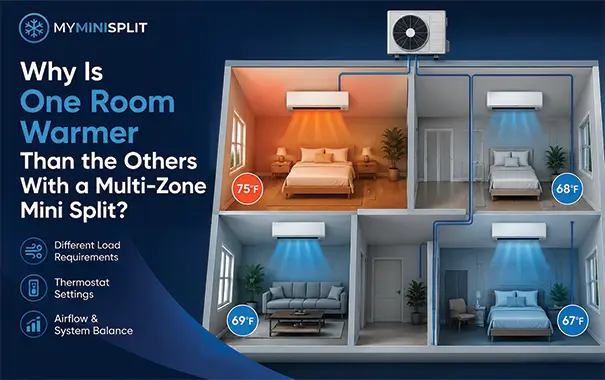
A multi-zone mini split is designed to give different rooms independent temperature control. So when one room is warmer than the others, the problem is usually not that the entire system has stopped working. More often, that zone has a different load, weaker airflow, a setting problem, a placement issue, or less available capacity while other zones are running.
The quickest way to narrow it down is to compare what the warm room is doing with what the other indoor units are doing. Is the head blowing little or no air? Is the airflow strong but not cold? Does the room become warm only in the afternoon, only when every zone is calling, or all the time? Each pattern points to a different next step.
Quick answer
One room can be warmer than the others with a multi-zone mini split because:
- Its filter, coil, louver, or fan is restricting airflow.
- The remote, schedule, or operating mode is not calling for the same cooling.
- The indoor head is poorly placed or air is blocked by curtains, furniture, or a closed door.
- The room has a larger cooling load from windows, sun, a roof, appliances, people, or air leakage.
- Its indoor head is undersized, or the outdoor condenser is sharing limited capacity among several zones.
- A line-set, refrigerant, communication, electrical, or installation problem is affecting that circuit.
- The room has a building-envelope or humidity problem that the mini split cannot overcome by itself.
Start with the safe checks in this guide. If the warm room still cannot reach its set point after a stable run, have the complete system evaluated. A larger indoor head is not automatically the answer.
If the issue appears only when the other zones are off or on, first review whether you can run only one indoor unit on a multi-zone mini split and then use the symptom pattern below to separate normal low-load behavior from a problem.
Manufacturers describe multi-zone systems as independent comfort zones, but the indoor units still communicate their demands to one shared outdoor unit. Mitsubishi Electric explains that each indoor unit maintains its zone set point and sends changing demand to the outdoor unit; the demand varies with occupancy, activities, weather, and solar exposure. That is why a room can behave differently even when all heads are part of the same system. See Mitsubishi Electric’s multi-zone explanation for the operating concept.
First, identify what “warmer” means
There are two different complaints:
- The room is warmer than the others even though its indoor unit is running.
- The indoor unit is off, but the room drifts warmer than rooms whose heads are operating.
An inactive zone is not necessarily malfunctioning. If its door is closed, it may naturally gain heat from the sun, attic, adjacent rooms, occupants, or electronics. A multi-zone system can reduce or stop conditioning in an unused zone, so the room may not stay at the same temperature as an actively conditioned room.
If the head is running and the room remains several degrees warmer after the system has operated steadily, compare airflow, settings, room exposure, and simultaneous demand before assuming a refrigerant problem.
A fast symptom guide
| What you observe | More likely causes | First check |
| Little or no air from the warm head | Dirty filter, blocked return, fan setting, louver issue, control or communication fault | Clean the filter, confirm fan operation, and remove obstructions |
| Strong airflow, but the air is not cool | Wrong mode, high load, low refrigerant, coil problem, outdoor capacity limit | Confirm COOL mode and compare supply air with another head |
| Warm mainly in the afternoon | West-facing glass, solar gain, roof exposure, weak insulation, air leakage | Check sun, shades, attic/roof conditions, and window seals |
| Warm only when several zones run | Shared condenser capacity, approved-combination issue, simultaneous peak load | Run a controlled comparison with other zones, then check equipment data |
| Warm with the door closed | Room load, insufficient head capacity, poor air mixing, pressure imbalance | Check the head size and whether air can circulate inside the room |
| Head cycles on and off quickly | Oversizing, sensor location, restricted airflow, low-load limitation | Check sensor area, filter, and equipment sizing |
| Error code, ice, water, or unusual noise | Refrigerant, drain, electrical, coil, or installation problem | Turn off if necessary and call a qualified technician |
This table is a starting point, not a diagnosis. Two symptoms can occur at the same time—for example, a west-facing room may also have a dirty filter.
Ten-minute checks you can do safely
These checks do not require opening the refrigerant circuit or electrical compartment.
1. Confirm the operating mode
Make sure the warm room is in COOL mode when the other zones are cooling. FAN mode only circulates room air. DRY mode uses a different control strategy, and AUTO may choose an unexpected response depending on the model and sensor reading.
If the system is being used for heating, reverse the comparison: verify HEAT mode and look for drafts, cold glass, or a head that is not delivering warm air. Do not assume every brand permits conflicting heat and cool requests on the same outdoor unit; follow the exact operation manual.
2. Compare set points and schedules
Check the wall controller, handheld remote, and app. A schedule, sleep setting, energy-saving mode, child lock, or vacation setting may have changed one zone’s target. Compare the displayed set point with a separate thermometer placed away from the head and out of direct sunlight.
Lower the set point a few degrees for testing, but do not use an extreme setting as a permanent workaround. A lower number cannot compensate for an undersized head, a blocked coil, or insufficient outdoor capacity.
3. Inspect airflow
With the head running, stand several feet away and compare its airflow with a cooler room. Check that the intake is not covered and that the discharge louver is open and aimed into the room. Curtains, tall cabinets, beds, shelving, and decorative covers can short-circuit the air path.
Air does not reliably turn a corner through a narrow doorway. If the indoor head is at one end of a long room, behind an obstruction, or aimed at a wall, the thermostat may sense a cool pocket while the occupied area remains warm.
4. Clean the filter
A dirty filter reduces airflow and can allow the coil to become too cold or dirty. Follow the product manual for removing and washing or vacuuming the filter, and let a washable filter dry before reinstalling it. If the filter is clean but airflow is still weak, the indoor coil, blower wheel, louver motor, or control board may need service.
5. Look at the outdoor unit
Leaves, plastic, lint, landscaping, or a tightly enclosed location can restrict the outdoor coil. Keep the clearances specified by the manufacturer. Do not spray or disassemble the unit while it is powered, and do not cover it during normal operation.
6. Check doors and windows
For a closed bedroom or office, keep exterior windows and doors closed while testing. For an open-plan space, leave interior doors positioned as they are normally used. A mini split is not a central duct system; a closed door can isolate heat in the room.
7. Check the sensor location
The head’s sensor may be near the return air, high on a wall, near a warm ceiling, or in a draft from another space. A remote temperature sensor may be available on some models. If a portable thermometer reads much warmer at the desk or bed than the controller reports, note both readings for the technician.
8. Check all active zones
Write down which zones are on, their modes, and their set points. Note whether the warm zone improves when one or more other zones are temporarily turned off. This is a useful diagnostic observation, not a permanent operating strategy.
9. Listen and look for warnings
Ice on the indoor coil, a drain overflow, repeated error codes, a tripped breaker, hissing, or a line set that is not insulated are reasons to stop experimenting and call a qualified professional.
10. Give the system time to stabilize
Inverter systems modulate rather than delivering one constant output. After changing a setting, allow a reasonable, steady run and measure the room away from the discharge air. Comparing temperatures immediately after a door opens or a set point changes can produce a misleading result.
Cause 1: The warm room has a different heat load
Two rooms with the same floor area can need very different amounts of cooling. A west-facing bedroom with large glass, a top-floor office below a roof, and a shaded interior bedroom are not equivalent loads. Occupants, computers, lighting, cooking appliances, ceiling height, insulation, infiltration, and neighboring unconditioned spaces also matter.
This is why the correct indoor head is selected for the room it serves rather than by dividing a condenser’s BTUs evenly. ACCA describes Manual J as the ANSI-recognized residential load-calculation standard. The calculation accounts for details such as windows, solar exposure, infiltration, internal gains, and moisture. Manual S then explains how to select equipment using those loads, local design conditions, and manufacturer performance data.
For multi-room projects, compare the room-by-room methods in our two-zone mini split sizing guide and three-zone mini split sizing guide before changing one indoor head. Those guides explain why equal square footage does not always justify equal BTU ratings.
An undersized head may deliver cold air yet never remove the room’s full peak load. The room feels warmest during the afternoon or when several people are present. An oversized head creates a different problem: it may satisfy the sensor quickly, cycle or modulate near its minimum, and provide less consistent humidity control. Do not fix a warm room by ordering the next larger head without a load calculation and a compatibility check.
For a preliminary estimate, use the MyMiniSplit calculator, then have a qualified HVAC professional verify the room-by-room loads.
Cause 2: The indoor head is poorly placed
Placement determines how well the air reaches the occupied part of the room. A wall-mounted head should have a clear intake and discharge path, adequate service access, and a sensor location that represents typical room conditions.
Common placement problems include:
- A head installed behind a curtain or close to a high cabinet
- Discharge air aimed at a wall instead of across the room
- A head mounted where a door or beam blocks the throw
- A bed, desk, or sofa located in a stagnant corner
- A ceiling cassette with its airflow blocked by a beam or light fixture
- A concealed or ducted head with an obstructed grille or poorly balanced short duct
A portable fan can help mix air in a large room, but it cannot correct a blocked return, a wrong head location, or an undersized system. If the warm area is far from the head, improving air distribution may be more effective than lowering the set point.
Cause 3: A filter, coil, or louver is restricting the zone
The warm head may be receiving refrigerant normally but moving too little air. Dust on the filter, a dirty indoor coil, a fouled blower wheel, a stuck louver, or a fan that never reaches its selected speed can all reduce delivered capacity.
Compare the air volume and temperature from the warm head with an otherwise similar head. A noticeably weaker stream is evidence to investigate airflow first. A technician can measure temperature split, static pressure where applicable, coil condition, fan operation, and electrical signals without guessing from the remote display.
Do not bend coil fins, use harsh chemicals, or spray water into electronics. Follow the manual for homeowner cleaning and leave deep coil and blower cleaning to a professional.
Cause 4: The settings are not actually equivalent
One zone may be in FAN, DRY, ECO, SLEEP, or a scheduled setback while the others are in normal COOL. Its set point may also be higher, or the controller may be reading a cooler location near the ceiling.
Some multi-zone heat-pump systems also limit which modes can operate together. A mixed HEAT/COOL request or AUTO selection can result in one indoor unit waiting, changing mode, or not delivering the output you expect. The exact behavior is model-specific, so check the owner’s manual rather than assuming that every multi-zone system handles mode conflicts the same way.
This matters when you are testing a single zone. Our guide to running one indoor unit on a multi-zone mini split explains what the outdoor unit may do when the other heads are idle and why model-specific minimum-output limits still matter.
When troubleshooting, place all active zones in the same requested mode, use comparable fan settings, disable temporary schedules, and record the settings. Restore normal preferences after the test.
Cause 5: The outdoor condenser is sharing capacity
Multi-zone systems connect several indoor units to one outdoor condenser. Each head can request capacity independently, but the condenser has a finite cooling and heating output at any moment. Mitsubishi describes the indoor units as continuously communicating their changing demand to the outdoor unit; that demand changes with occupancy, weather, and sun exposure. The outdoor inverter then responds to the combined request.
If you are planning a replacement, start with the multi-zone mini split collection, then compare the available 2-zone, 3-zone, 4-zone, and 5-zone systems only after the loads and compatibility data are known.
If several rooms reach peak load at the same time, the warm zone may receive less than its indoor unit’s nominal BTU rating. This is especially relevant when:
- The connected indoor capacity is close to the product family’s maximum
- Three or more sunny rooms call for cooling at once
- A large living area and several bedrooms share one condenser
- The system was selected using assumed diversity that does not occur in the home
- One indoor model or port is not part of the condenser’s approved combination
If the warm room improves quickly when other zones are turned off, tell the contractor. That pattern can point toward simultaneous-capacity limits, equipment selection, line-set issues, or a control problem. It does not prove that the condenser is undersized; the model’s performance tables and approved combinations must be checked.
Review the exact indoor and outdoor model numbers, connected-capacity range, cooling capacity at design conditions, line lengths, elevation, and any manufacturer limits. A 30,000 BTU nameplate, for example, does not guarantee 30,000 BTUs delivered to every active head at the same time.
Cause 6: The head is undersized for its room
An indoor unit that is too small may run continuously while the room remains above its target. Look for a pattern: strong, consistently cool airflow; a warm room that worsens in sun or with occupants; and improvement when outdoor conditions become milder.
If you are unsure whether the head is correctly sized, use our guide to choosing the right mini split size for a room before requesting a replacement.
The correct response is not automatically “buy the biggest head.” The contractor should recalculate the room, review the indoor unit’s operating range, confirm the outdoor combination, and check whether the room needs better shading, insulation, air sealing, or a different indoor-unit style.
If a replacement head is being considered, do not mix it into the existing system based only on brand and BTU. Exact model compatibility, controls, refrigerant, ports, and approved combinations matter.
Cause 7: Refrigerant or line-set trouble is affecting one circuit
A leak, undercharge, kinked line, poor flare, incorrect additional-charge calculation, inadequate insulation, or a line-set that exceeds the manufacturer’s limits can reduce performance at one indoor unit. A branch or port mismatch can create similar symptoms on some systems.
Possible warning signs include weak cooling compared with the other heads, frost or ice, hissing, oily residue near a flare, long run times with little temperature change, or a technician’s pressure and temperature readings that do not match the expected range.
Refrigerant diagnosis and charging require the correct tools, recovery procedures, and certification. Do not open service valves or add refrigerant from a can. A qualified technician should leak-test, verify the line-set installation, confirm communication, and use the manufacturer’s service data.
Cause 8: The room itself is adding heat or moisture
The mini split may be working normally while the room is gaining heat faster than expected. Check for:
- Direct sun through west or south-facing windows
- An uninsulated attic, roof, or wall above the room
- Air leakage around doors, windows, recessed lights, or plumbing penetrations
- A garage, porch, or other unconditioned space next to the room
- Computers, televisions, lighting, or appliances
- More occupants than the original design assumed
- A door undercut or pressure path that pulls hot, humid air into the room
In a humid climate such as Miami, comfort also depends on moisture removal. A room can feel warmer or clammy when the system runs in short bursts, the coil is dirty, or infiltration is high. Window shades, weatherstripping, insulation repairs, and air sealing can lower the load, but they should complement—not replace—HVAC diagnosis.
Cause 9: The room is stratified or the thermometer is misleading
Warm air collects at the ceiling, and a high wall sensor may not represent the temperature at the bed or desk. A thermometer placed in discharge air, beside a sunny window, or near a television can also mislead you.
For a useful comparison, place thermometers at similar heights in each room, away from supply air, windows, exterior doors, and heat-producing equipment. Compare after the doors and windows have been in their normal position and the system has operated steadily. If the reading at occupant level is consistently warmer than the controller reports, ask whether the model supports a remote sensor or a sensor-location adjustment.
What to do if the room is warm only when other zones run
Use this as a controlled observation:
- Put all zones in the manufacturer-approved cooling mode.
- Record each set point and the room temperatures.
- Operate the warm zone with the other zones temporarily off.
- Repeat with the normal number of zones active.
- Note whether airflow, supply temperature, error codes, or run time changes.
If the warm room performs well alone but not during normal simultaneous use, ask the contractor to review the condenser’s available capacity at the actual outdoor temperature, the indoor combination, and the room loads. If it performs poorly even alone, prioritize airflow, sizing, placement, and circuit-specific service checks.
Do not use “turn off the other rooms” as the permanent solution. It may hide a capacity or design problem and leave other occupants uncomfortable.
Can opening doors or adding a fan fix the warm room?
Sometimes a fan or open door helps distribute air between adjacent spaces, especially in an open-plan area. It is not a substitute for a dedicated indoor head in a closed room. A closed bedroom with a high solar load still has to reject its own heat; air from a hallway may not move enough to do that.
For more detail on airflow between enclosed spaces, read Can One Mini Split Cool Two Rooms? and compare the limitations of shared air with the control provided by separate indoor heads.
If the home’s layout has changed, consider whether the original zoning still matches how rooms are used. A finished attic, new office, removed door, or added glass can change the load and air-distribution plan.
When to call an HVAC professional
Arrange service when the warm room has any of these conditions:
- It does not reach the set point after proper mode, filter, airflow, and door/window checks.
- The airflow is much weaker than other heads.
- Ice, water, oil residue, hissing, or repeated error codes appear.
- The outdoor unit runs but the warm head never delivers comparable cooling.
- The breaker trips, wiring smells hot, or the unit stops unexpectedly.
- The room is comfortable only when other zones are turned off.
- The problem began after installation, a repair, a line-set change, or a new indoor head.
- The room’s use, windows, insulation, or occupancy changed after the system was designed.
Ask for a written diagnosis that separates building load, indoor airflow, equipment capacity, and refrigerant or control issues. A useful visit should include the exact model numbers and installation data, not just a recommendation to lower the thermostat.
Common mistakes that make one-room temperature problems worse
Buying a larger head immediately
Oversizing can create short cycling, drafts, poor humidity control, and an unapproved indoor-outdoor combination. Recalculate the room first.
Leaving the zone in AUTO during diagnosis
AUTO can obscure whether the unit is actually calling for cooling or heating. Use the mode required by the manufacturer while testing.
Comparing only the remote displays
Two remotes can show identical set points while the rooms have different actual temperatures or sensor readings. Use calibrated, similarly placed thermometers.
Cleaning the indoor filter but ignoring the outdoor unit
Both coils and the airflow paths matter. Follow safe cleaning instructions, then have a professional inspect hidden restrictions.
Assuming the BTU total tells the whole story
Indoor nameplate ratings, outdoor nominal capacity, approved combinations, operating ranges, and simultaneous performance are separate checks.
Our guide to the top mini split buying mistakes covers related sizing and compatibility errors that can lead to uneven comfort.
Adding refrigerant without testing
Adding charge without finding a leak or verifying the manufacturer’s data can damage the system and create unsafe conditions.
Treating a temporary improvement as proof
If turning off other zones helps, that is a clue. It is not conclusive proof of an undersized condenser until the loads and performance data are reviewed.
One-room-warmer troubleshooting checklist
Before scheduling service, record:
- The warm room’s actual temperature and set point
- The other rooms’ actual temperatures and set points
- Mode, fan speed, louver position, schedules, and app settings
- Whether the warm room’s airflow is weaker than the others
- Filter-cleaning date and any visible coil or louver issue
- Time of day and weather when the problem is worst
- Whether the issue occurs with one zone or several zones active
- Any error code, ice, water, unusual noise, or breaker event
- Indoor and outdoor model numbers
- Approximate line-set lengths and any recent installation changes
This information helps a technician distinguish an operating-setting issue from a room-load, shared-capacity, or installation problem.
The bottom line
One room warmer than the others with a multi-zone mini split does not automatically mean the system is defective. Begin with mode, set point, schedule, filter, airflow, sensor, door, and outdoor-unit checks. Then look at the room’s unique heat load and indoor-head placement.
If the room is warm only when several zones run, the shared condenser’s available capacity and the exact approved indoor combination deserve attention. If the room is weak even when it runs alone, investigate airflow, sizing, refrigerant, line-set, communication, and installation conditions.
The durable fix comes from matching the room load, indoor unit, outdoor performance, and building envelope—not from repeatedly lowering the set point or buying a larger head by guesswork.
For background on selecting equipment by room, read How to Size a Ductless Mini Split Air Conditioner and How to Choose the Right Mini Split Size for Your Room. If you are comparing system architectures, see Single-Zone vs Multi-Zone Mini Split: Which Costs Less Over Time?.
Frequently Asked Questions
Why is one room warmer than the others with a multi-zone mini split?
The warm room may have weaker airflow, a dirty filter, different settings, a larger solar or internal heat load, poor head placement, an undersized indoor unit, shared outdoor capacity limits, or a circuit-specific installation problem. Compare the room’s airflow and settings first, then have the complete system evaluated if it still misses the set point.
Can a dirty filter make one mini split room warmer?
Yes. A dirty filter can restrict airflow and reduce the head’s ability to transfer cooling into the room. Clean it according to the manufacturer’s instructions. If airflow remains weak, the coil, blower, louver, or controls may need professional service.
Why does the room get warmer only when all the zones are running?
The indoor heads share the outdoor condenser’s available capacity. When several rooms call at once, the warm zone may receive less output than its nominal indoor rating. The contractor should verify simultaneous capacity, the approved indoor combination, line lengths, and the actual room loads.
Can the wrong BTU size cause one room to stay warm?
Yes. An undersized indoor head may run for long periods and still fall short during peak conditions. However, an oversized replacement can create other comfort problems and may not be compatible with the condenser. Use a room-by-room load calculation and the manufacturer’s combination data before changing sizes.
Can a closed door make a room warmer with a mini split?
Yes. A ductless head conditions the space where it is installed; it does not move air through a closed door like a central duct system. A closed room with a high heat load may need its own correctly sized head and better air circulation.
Should every indoor unit be in the same mode?
For troubleshooting, use the same manufacturer-approved mode on all active zones. Some multi-zone heat-pump systems limit mixed heating and cooling, and AUTO can create unexpected operation. Exact rules vary by model, so follow the owner’s manual.
Can a refrigerant leak affect only one indoor unit?
It can. A leak, restriction, poor flare, kinked line, or communication issue may reduce performance on one circuit. Ice, hissing, oily residue, or weak cooling are warning signs. Refrigerant work should be performed by a qualified technician.
Is the outdoor condenser too small if one room is always warmer?
Possibly, but not necessarily. The warm room could instead have a high solar load, poor airflow, wrong settings, or an installation fault. If it improves when other zones are off, check the condenser’s performance data and approved combination against the home’s simultaneous loads.
Can a fan solve an uneven-temperature problem?
A fan can mix air and help an open-plan room, but it cannot correct a blocked return, undersized head, low refrigerant, poor insulation, or an isolated closed room. Treat it as an airflow aid, not a replacement for diagnosis.
When should I call a professional for a warm mini split room?
Call when the room remains warm after basic setting, filter, airflow, and door/window checks, or whenever you see ice, water, error codes, unusual noise, breaker trips, or signs of a refrigerant leak. Request a diagnosis that checks room load, indoor airflow, shared capacity, line sets, controls, and refrigerant—not just the thermostat setting.