

Choose the copper pipe diameters specified for your exact mini split model. Common line set pairs include 1/4 × 3/8 inch, 1/4 × 1/2 inch, and 3/8 × 5/8 inch, but systems with the same BTU rating can require different sizes. Check both the indoor and outdoor model numbers before ordering.
The two numbers describe the outside diameters of the copper tubes. The line set’s length, insulation thickness, and connection type are additional specifications you need to match.
What do the two line set sizes mean?
A mini split line set contains two refrigerant tubes connecting the indoor and outdoor units. Product listings commonly label the smaller tube the liquid line and the larger one the gas or suction line. Refrigerant flow and conditions change when a heat pump switches operating modes.
In a listing labeled 1/4-inch liquid × 1/2-inch gas, 25 feet, you are looking at a pair of tubes with different diameters, each approximately 25 feet long.
Check the labels beside the numbers. Some manufacturer tables list gas first, while many stores list liquid first.
Outside diameter, insulation, and fitting size
ACR copper tubing is sized by its actual outside diameter, often shortened to OD. Measure the bare copper to identify that dimension. Measuring over the insulation gives you a different number.
A flare fitting has its own dimensions, too. A 1/4-inch tube can connect to a fitting with a larger thread diameter. Match the tube size, thread specification, and flare connection using the equipment documentation.
Common copper pipe sizes in inches and millimeters
| Copper tube outside diameter | Metric equivalent, rounded |
| 1/4 inch | 6.35 mm |
| 3/8 inch | 9.52 mm |
| 1/2 inch | 12.70 mm |
| 5/8 inch | 15.88 mm |
| 3/4 inch | 19.05 mm |
| 7/8 inch | 22.23 mm |
Manufacturers may round the same size differently, such as 9.52 or 9.53 mm for 3/8 inch. The Copper Development Association’s handbook explains ACR tubing dimensions and sizing conventions.
Mini split line set size chart by BTU
The table below shows specific Senville indoor-unit examples, so you can see how pipe diameter often changes with capacity. Use the full model number to confirm your equipment’s requirements.
| Listed indoor model | Capacity | Liquid tube OD | Gas/suction tube OD |
| SENA-09HF-IAA | 9,000 BTU/h | 1/4 inch | 3/8 inch |
| SENA-12HF-IAA | 12,000 BTU/h | 1/4 inch | 3/8 inch |
| SENA-18HF-IAA | 18,000 BTU/h | 1/4 inch | 1/2 inch |
| SENA-24HF-IAA | 24,000 BTU/h | 3/8 inch | 5/8 inch |
| SENA-36HF-IAA | 36,000 BTU/h | 3/8 inch | 5/8 inch |
These examples come from Senville’s model-specific line set guide.
Why a universal BTU chart can lead to the wrong purchase
Pipe sizes can differ even within one brand. For example, Pioneer lists 1/4-inch liquid × 3/8-inch gas for the WYT018GLUI17RL indoor unit and 1/4-inch liquid × 1/2-inch gas for the WYT018GLSI24RL. Both are in the 18,000 BTU/h class. You can check those entries in Pioneer’s line diameter selection guide.
This is why a product title such as “line set for 18,000 BTU mini split” is only a starting point. The required diameters and approved connections determine compatibility.
How to choose the right line set before buying
1. Find both equipment model numbers
Use the full indoor and outdoor model numbers, including the series and suffix. For a multi-zone system, record each indoor model and its assigned outdoor connection.
Look in the installation manual or submittal sheet for “refrigerant piping,” “liquid pipe diameter,” and “gas pipe diameter.” If the manual and a seller’s general description disagree, ask the manufacturer to confirm the correct specification before ordering.
2. Match the tubing and connection type
Check both copper diameters and whether the system uses conventional flare connections or a proprietary factory-sealed connection.
A conventional pre-flared line set has prepared tube ends and flare nuts. A factory-sealed, precharged quick-connect assembly has additional compatibility requirements, including the approved connectors, refrigerant, and equipment generation. Similar wording in a product listing does not establish that the connections are interchangeable.
For example, our 25-foot copper line set with 3/8-inch and 5/8-inch tubing lists flare nuts. Confirm the complete specification against your equipment before purchasing.
3. Check the route length and vertical rise
Measure the actual route around corners and through the building. Then compare it with the model’s length, elevation, and charging requirements.
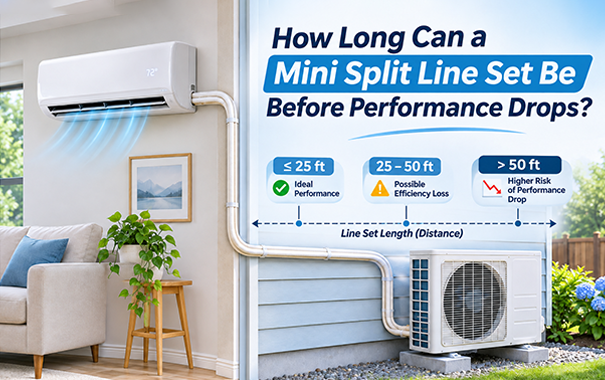
Ask for manufacturer approval before changing pipe diameter to accommodate a longer run. Our guide to how line set length affects mini split performance covers the distance limits and capacity checks.
4. Confirm the copper specification and insulation
Your installer should verify the tubing material, wall thickness, pressure suitability, insulation, and approved joining method. A matching outside diameter alone does not establish suitability for the equipment.
Select tubing intended for refrigeration service that meets the manufacturer’s requirements. Keep its interior protected from moisture and debris during storage and installation. When comparing mini split line sets and accessories, check what is included, such as flare nuts, insulation, and communication cable.
What happens if the pipe size is wrong?
Tubing that is too small can cause excessive pressure loss. Oversized gas piping can reduce refrigerant velocity and affect oil return to the compressor. The effect depends on the system and operating conditions, which is why the approved diameter matters.
An adapter can be part of a manufacturer-approved installation, especially on multi-zone equipment. It changes the connection size at that point. It does not establish that any tube diameter will work along the entire run.
There is no single percentage loss that applies to every wrong-size line set. If an installed system performs poorly, have the technician verify the piping against the manual alongside airflow, refrigerant charge, leaks, and other possible causes.
Do multi-zone mini splits use the same pipe size for every room?
They may, but each branch needs to match the approved equipment configuration. A smaller bedroom head and a larger living-room unit can require different tubing or manufacturer-specified adapters at the condenser.
Systems with branch boxes or shared main piping also have requirements for those sections. Size each section from the manufacturer’s piping diagram and tables. Our two-zone mini split sizing guide explains how to match the indoor heads and outdoor unit before selecting the installation materials.
What matters in Miami and South Florida?
Pipe diameter still comes from the equipment specifications. South Florida’s humidity makes the insulation and route especially important.
Have the installer check the required insulation on each pipe, seal the joints, and protect exposed insulation as the manufacturer directs. Gaps can allow moisture to reach cold surfaces and form condensation. Make sure the line cover has room for both insulated tubes, wiring, and any drain routed with them.
For a condo, confirm the approved route and access before ordering materials. Our Miami condo mini split guide covers piping condensation, placement, and the details to include in the installation quote.
Before you buy, send the supplier your indoor and outdoor model numbers, required pipe diameters, connection type, and measured route length. That gives them the information needed to check the line set against the equipment.
Frequently asked questions
What size line set does a 12,000 BTU mini split use?
Some 12,000 BTU/h models use 1/4-inch liquid and 3/8-inch gas tubing, while others specify a different pair. Check the exact model’s installation manual before buying.
Can I use a larger copper pipe on a mini split?
Use a different diameter only when the manufacturer permits it for the equipment and piping arrangement. Larger tubing changes refrigerant flow and may affect oil return.
Are mini split pipe sizes inside or outside diameter?
Mini split ACR copper tube sizes refer to outside diameter. Measure the bare copper and check the equipment specification. Insulation thickness and flare-fitting dimensions are separate measurements.
Can I reuse the copper line set when replacing a mini split?
Possibly, if the new manufacturer permits reuse and the existing tubing meets its requirements. Have the installer check diameters, wall thickness, condition, cleanliness, connections, insulation, and the complete route before approving reuse.
Do R-410A, R-32, and R-454B systems use different pipe sizes?
Refrigerant type alone does not determine pipe diameter. Use the exact model’s piping specifications and approved components. For precharged assemblies, also verify the refrigerant and connection system explicitly.