

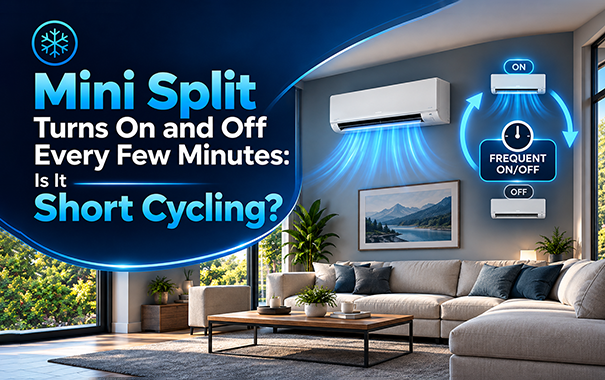
A mini split turning on and off every few minutes may be short cycling, but intermittent airflow alone does not prove it. The concern is repeated brief compressor runs—not simply the indoor fan changing speed or stopping. Check whether the room reaches its set temperature, whether the system shows an error, and what the exact model’s manual says about normal operation.
Inverter mini splits can slow down, pause, and restart as demand changes. Some also cycle their indoor fans while monitoring temperature. Repeated shutdowns while the room still needs cooling, especially with poor comfort, ice, or fault codes, deserve investigation.
Start with the distinction below before ordering parts or choosing a larger system.
Quick check: normal operation or possible short cycling?
| What you notice | What it may mean | Your next step |
| Airflow gets quieter, but room temperature stays steady | Fan control or reduced inverter output | Compare with the model’s normal operating instructions |
| The indoor fan starts and stops near the set temperature | Temperature-monitoring or energy-saving fan behavior | Check the operating mode and manual; this alone is not a compressor diagnosis |
| The compressor repeatedly stops after brief runs while the room remains uncomfortable | A control, airflow, load-matching, or protection issue | Record the pattern and arrange service if basic checks do not resolve it |
| The unit pauses after you turn it off and immediately back on | A compressor restart-protection delay | Leave the controls alone and allow the manual’s stated delay |
| Heating pauses during cool weather, then resumes | Possible defrost or warm-up control | Compare the indicators and sequence with the manual |
| The display repeatedly resets or the breaker trips | Possible power or electrical fault | Stop testing and contact a qualified professional |
These are clues, not confirmed causes. A technician may need operating data to establish whether the compressor actually stops and why.
What is mini split short cycling?
Short cycling describes repeated, unusually brief compressor operation that interrupts the system’s normal heating or cooling response. It can reduce comfort, disrupt moisture removal, and increase equipment wear.
Trane’s short-cycling guidance distinguishes abnormal frequent cycling from operation that changes with weather and demand. Its central-system timing examples should not be applied as universal limits for every ductless model.
There is no single “under 10 minutes” rule that diagnoses every mini split. An inverter system, an older fixed-speed unit, and a multi-zone condenser can behave differently. A brief run near the target temperature in mild weather tells you less than repeated stops while substantial cooling is still needed.
Identify what is actually turning off
Separate four observations:
- Indoor airflow: The blower may slow down, stop, or run intermittently.
- Outdoor fan: Visible fan movement alone does not establish compressor operation.
- Compressor: It can change speed independently of what you notice indoors.
- Controls and display: A dark display may reflect a display setting rather than loss of power.
On a multi-zone system, one indoor head can stop conditioning while the outdoor unit continues serving another room. Avoid describing that as the whole system shutting down.
Observe from a safe distance. Do not open electrical covers, reach through a fan guard, or touch components to determine whether the compressor is running.
When starting and stopping can be normal
The room has reached its target
An inverter reduces output within its operating range. If demand falls below what it can deliver continuously, it may stop and restart later. That does not establish a failed compressor.
ACCA explains that variable-capacity equipment has model-specific minimum and maximum output. The minimum matters during mild weather and in small rooms, as well as the maximum during hot afternoons.
The indoor fan is following its control program
Some models use intermittent fan operation after reaching the set temperature. GENERAL’s R32 H-series fan-control bulletin documents this behavior for specific Australian models and settings.
That bulletin illustrates why fan cycling can be intentional; it does not establish the normal timing for a different U.S. model. Use your own indoor-unit model number and manual.
DRY mode can also change airflow and compressor behavior. A humidity-control sequence should not be judged against an assumed continuous-cooling pattern.
A restart delay is protecting the compressor
After stopping the unit, changing modes, or losing power, the compressor may not restart immediately. Fujitsu AIRSTAGE’s U.S. troubleshooting guidance describes an approximately three-minute protection delay for the equipment covered by that guidance.
A delay after your own control change is different from unexplained shutdowns during an ongoing cooling request. Repeatedly pressing ON/OFF can make the sequence harder to interpret.
Heating is paused for defrost or warm-up
Heat pumps may temporarily interrupt indoor heating to defrost the outdoor coil. The indoor fan can also wait while the coil warms up.
Check the model’s indicator behavior and expected recovery. Defrost is a heating-mode explanation; it does not explain repeated shutdowns during ordinary COOL operation in a Miami summer.
Stop troubleshooting if you see these warning signs
Stop operation and arrange service for a burning smell, overheated wiring, repeated breaker trips, severe unusual noise, visible indoor-coil ice, or water leaking from the indoor unit. If smoke or fire is present, move away and call emergency services.
Use the normal control to stop the system when safe. Have a qualified person handle power isolation if the electrical equipment is wet, damaged, or inaccessible. Do not repeatedly reset a tripped breaker to keep the unit running.
Pioneer’s troubleshooting table identifies overheating and abnormal operating symptoms as reasons to stop the covered equipment. Trane’s compressor troubleshooting guidance also advises service after a breaker trip.
If the coil is iced, stop cooling. Do not chip ice away, apply a heat gun, or restart just because the ice melts. The underlying airflow or refrigerant problem may remain.
Safe checks before calling for service
If there are no warning signs, work through these checks. Change one thing at a time so you can tell what affected the pattern.
1. Confirm the mode, temperature, and schedules
For a hot room, confirm COOL mode and a reasonable comfort setting below the measured room temperature. Check the wall controller, remote, app, and any connected smart controller for timers, sleep settings, occupancy rules, or schedules.
Keep the settings stable while observing. Do not use an extreme temperature as a permanent way to force the compressor to run. Leave enough time for the model’s restart delay and normal response.
AUTO operating mode and AUTO fan are separate settings. On multi-zone equipment, also check whether the active heads are requesting compatible modes.
Daikin’s troubleshooting guidance includes mode, temperature, timer, and obstruction checks before service. Our Miami mini split temperature and fan settings guide explains how to assess comfort and humidity alongside those controls.
2. Check the homeowner-serviceable filters
Stop the unit and follow its manual before removing accessible filters. Clean reusable filters as instructed, let them dry completely, and reinstall them correctly. Replace disposable elements according to their instructions.
Restricted airflow can contribute to poor cooling and coil icing. A clean filter does not prove that the coil or blower wheel is clean, so persistent weak airflow may need professional cleaning or repair.
Do not run the unit without its filters or spray cleaner into the electronics. Trane’s mini split cooling guide discusses filters, frozen coils, and refrigerant problems as separate checks.
3. Look for blocked airflow
Move curtains, furniture, and other objects away from the indoor intake and discharge. Check whether the air immediately hits an obstruction instead of circulating through the occupied area.
From a safe outdoor location, look for loose debris or vegetation blocking the condenser. Maintain the clearances in the installation manual. Leave covers, internal cleaning, fan repairs, and inaccessible rooftop equipment to a professional.
Poor air circulation can create a cool pocket near the indoor unit while the seating area remains warm. Extra BTUs cannot correct every distribution problem.
4. Compare room conditions with the controller
Place a separate thermometer away from direct sun and the supply-air stream. Record the occupied area’s temperature and humidity alongside the controller setting.
The controller may show the target temperature rather than a measured room temperature. Some systems sense return air at the head; others use a supported remote sensor. Ask which sensor controls your model before interpreting a difference as a fault.
If the head stops while another part of the room remains warm, document the placement and airflow pattern. Do not relocate or insulate an internal sensor yourself.
5. Record several operating sequences
If the equipment remains safe to run, note the start and stop times over several sequences. Include the mode, setting, room temperature, other active zones, and any blinking lights or codes.
Say exactly what you observed: “The indoor airflow stopped” is more useful than assuming “the compressor stopped.” A short video of the indicators and sound can help, but it does not replace a technician’s measurements.
What can cause repeated brief compressor runs?
Too much minimum capacity for the current load
A system can have enough peak capacity but still be a poor match when a room needs very little cooling. That can happen with an oversized unit, a shaded bedroom at night, or a shared condenser serving only one small active zone.
Low-load cycling is not automatically a hardware failure. Persistent rapid cycling with humidity problems may still justify checking the equipment match.
Have the installer compare a room-specific load calculation with the exact model’s operating range. Manual J calculates residential loads, while Manual S guides equipment selection using performance data.
Our guide to choosing the right mini split size explains the sizing tradeoffs. Do not buy a replacement from floor area or the cycling pattern alone.
Temperature sensing or controller problems
A sensor fault, unsuitable sensing location, or conflicting control command can interrupt operation. A cool pocket near the head can also make the system respond differently from what you feel at the sofa.
The technician should verify the active sensor, its readings, controller compatibility, and operating commands. Replacing the thermostat without confirming the control arrangement may not address the problem.
Airflow, refrigerant, or protection issues
Dirty coils, fan faults, refrigerant-charge problems, or other operating conditions can reduce performance or trigger protective controls. The shutdown response depends on the model.
Ice, weak airflow, or poor cooling helps direct the investigation, but none identifies the refrigerant charge by itself. Ask for a diagnosis rather than a routine “top-up.” A technician should check charge and leakage using the manufacturer’s procedures.
If ice melts and water appears at the head, our mini split water-leak guide explains related drainage and airflow issues. A condensate-pump noise is also separate from compressor cycling.
A condensate safety device is stopping operation
Some installations have a pump or overflow safety switch wired to stop the air conditioner when condensate rises too high. This depends on the installed equipment and wiring; it is not a feature of every wall head.
Aspen’s Silent+ Mini White instructions describe a high-level safety switch that can stop the air-conditioning system. If shutdowns coincide with a pump alarm or drainage trouble, have the pump, drain, and safety circuit checked. Never bypass the switch.
Electrical or inverter-control faults
Power instability, wiring problems, sensors, and inverter electronics can produce repeated stops. A missing error code does not rule them out.
GENERAL’s model-specific start-stop diagnostic note documents a case requiring professional electrical measurements even without a displayed fault. Its test values apply to the identified equipment, not every mini split.
Do not open the outdoor electrical enclosure to copy those tests. Inverter circuitry can retain dangerous voltage after power is disconnected.
Why multi-zone cycling needs a separate check
If only one small room is active, the shared condenser may encounter a much lower load than when several rooms call together. If one head pauses while another continues cooling, the compressor may still be running.
Record which heads are active when the pattern occurs. Ask the technician to check approved indoor/outdoor combinations, one-zone minimum output, and model-specific controls.
Read our guide to running one indoor unit on a multi-zone mini split for that operating distinction. If the main symptom is uneven room temperature, our one-room-warmer troubleshooting guide covers load and airflow checks.
Turning on unused rooms simply to keep the condenser running is not a permanent correction for an unsuitable equipment match or a fault.
Why short cycling matters in Miami and South Florida
Cooling performance includes moisture removal. A room can reach the desired temperature and still feel damp if the system does not meet the latent load—the moisture that must be removed.
Frequent brief cooling operation can make humidity control harder. Outdoor air leakage, door openings, and other moisture sources also matter, so do not attribute every damp room to cycling.
Measure relative humidity. EPA recommends keeping indoor humidity below 60%, ideally between 30% and 50% where possible. Persistent high humidity deserves assessment even if the air temperature looks acceptable.
Leaving a system enabled all day does not force it to operate continuously. Its controls still decide when to reduce output or stop. Our guide to leaving a mini split running all day discusses operating schedules; schedule changes do not repair a recurring shutdown fault.
What to give the technician
Send the indoor and outdoor model numbers, installation date, operating mode, set temperature, measured room conditions, and any codes. Include the observed run and off times, which component appeared to stop, and the other zones operating at that time.
Explain whether the behavior started at installation or appeared after previously steady operation. Note recent maintenance, power disturbances, controller changes, or room alterations.
Ask the technician to confirm whether each stop follows a satisfied temperature request, a control command, or a protective shutdown. That distinction helps separate sizing, control, airflow, drainage, and electrical work.
For an existing fault, contact a qualified local HVAC technician or your installer. If a confirmed equipment mismatch requires replacement, contact My Mini Split with the load calculation and model information to discuss equipment options.
Frequently asked questions
Is turning off every three minutes always short cycling?
No. First identify whether the indoor fan or compressor stops. Model-specific fan control and restart delays can involve several-minute intervals. Repeated brief compressor runs with poor comfort need investigation, but timing alone does not identify the cause.
Should an inverter mini split run without ever stopping?
No. An inverter has a minimum output. It may stop when demand falls below its operating range or when its control program calls for a pause. It should still maintain acceptable comfort under the intended conditions.
Can a dirty filter cause short cycling?
Restricted airflow can contribute to poor performance, icing, and protective shutdowns. Clean accessible filters according to the manual. If the pattern continues, the filter was not necessarily the only issue.
Does short cycling mean the mini split needs refrigerant?
No. Load mismatch, controls, airflow, electrical faults, and other causes can produce repeated stops. Have a technician verify the charge and check for leaks when indicated rather than adding refrigerant based on the symptom alone.
Will lowering the temperature fix it?
It may change how long the system calls for cooling, but it does not fix an electrical fault, sensor problem, blocked coil, or equipment mismatch. Use a reasonable comfort setting and investigate recurring shutdowns.
Does short cycling mean I need a new mini split?
Not necessarily. The cause may be a serviceable airflow, control, drainage, or electrical problem. Replacement becomes a separate decision after the fault or capacity mismatch has been confirmed.