

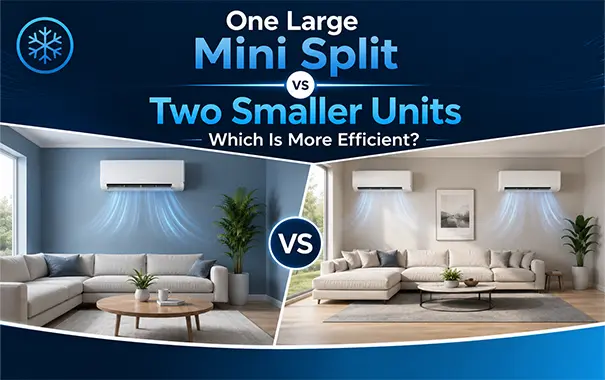
If you need about 24,000 BTUs of cooling, should you install one 24,000 BTU mini split or two smaller units that add up to the same capacity?
The short answer is: one properly sized larger mini split is often the more efficient and affordable choice for one open area, while two properly sized smaller units can use less energy in separate rooms or zones that are not always occupied at the same time.
The total BTU rating alone does not decide efficiency. The floor plan, room-by-room cooling load, equipment ratings, minimum operating capacity, installation quality, and the way you use each space all matter.
Quick Answer: One Large Unit or Two Smaller Units?
- Choose one larger single-zone mini split when the space is mostly open, has a fairly even cooling load, and is normally used as one zone.
- Choose two smaller single-zone systems when the areas are separated, have different comfort needs, or are occupied on different schedules.
- Consider a dual-zone mini split when you want two indoor units but prefer to connect them to one outdoor condenser.
Whichever arrangement you choose, correct sizing matters more than simply selecting the option with the highest BTU number. Our guide to choosing the right mini split size explains why both undersizing and oversizing can hurt comfort and performance.
First, Clarify What You Are Comparing
“Two smaller units” can describe two different arrangements:
- Two independent single-zone systems: Each indoor air handler has its own outdoor condenser, controls, refrigerant lines, and electrical connection.
- One dual-zone system: Two indoor air handlers share a single outdoor condenser but can usually be controlled as separate zones.
This article mainly compares one large single-zone system with two independent smaller single-zone systems. We will also explain when a dual-zone system may be the better compromise.
If your main concern is whether one indoor head can move enough air into separate rooms, read Can One Mini Split Cool Two Rooms? first. Capacity and airflow are two different problems: a unit may have enough BTUs on paper but still fail to distribute that cooling evenly through walls, doors, or hallways.
What Actually Determines Mini Split Efficiency?
A fair comparison requires more than adding the BTU ratings on the boxes.
Equipment efficiency ratings
Compare the exact models using ratings such as SEER2 for seasonal cooling efficiency and EER2 for efficiency under defined operating conditions. If heating matters, compare HSPF2 as well.
A high-efficiency 24,000 BTU model may outperform two average 12,000 BTU systems—or the reverse—depending on the equipment.
Part-load performance and minimum capacity
Inverter mini splits can reduce compressor speed as a room approaches its set temperature. However, every model has a minimum capacity below which it cannot continue modulating.
A large unit with a relatively high minimum output may cycle more often during mild weather or when the space needs only a little cooling.
Two smaller systems can match a divided load more closely because one unit can operate while the other remains off. But if both units run most of the time, their combined consumption and auxiliary electrical loads must be considered.
Room-by-room cooling load
Two homes with the same square footage can require different capacities because of ceiling height, insulation, windows, sun exposure, occupancy, appliances, air leakage, and the Miami-area heat and humidity.
Use the MyMiniSplit sizing calculator for an initial estimate, then have a qualified HVAC professional perform a room-by-room load calculation before purchasing equipment.
Layout and airflow
An indoor head cools the air it can effectively circulate. One large unit may work beautifully in a wide-open living area, but it cannot force balanced airflow through several closed doors.
Two smaller heads placed in the actual load zones often provide more even temperatures.
How the spaces are used
Real-world energy use depends heavily on operating time. If two areas are always occupied together, one efficient large unit may make sense.
If a home office is used during the day and a bedroom is used at night, separate systems let you condition only the active zone.
When One Large Mini Split Is More Efficient
One larger unit is usually the stronger option when all of the following are true:
- The area has an open or mostly open floor plan.
- Air can travel freely from the indoor head throughout the space.
- The entire area is normally occupied on the same schedule.
- The cooling load is reasonably balanced across the zone.
- A correctly sized model has good efficiency ratings and a useful modulation range.
One system also means one indoor head, one outdoor condenser, and fewer separate components drawing standby power. Installation is generally simpler, and there are fewer filters, drain lines, and condensers to maintain.
For example, a properly sized unit from the 24,000 BTU single-zone mini split collection may be a practical choice for a large, open living and dining area.
It is less likely to be a good solution for two closed bedrooms simply because its nameplate capacity is large enough.
When Two Smaller Mini Splits Are More Efficient
Two smaller systems can be more efficient in practice when they serve genuinely separate zones.
The rooms are occupied at different times
With independent systems, you can turn down or turn off the unit in an unused room instead of cooling the entire combined area. This is often the biggest energy-saving advantage.
The rooms have different cooling loads
A sunny west-facing office may need more cooling than a shaded bedroom of similar size. Separate units can respond to each room independently instead of making one thermostat and one airflow pattern serve both.
Doors are often closed
Closed doors prevent a single wall-mounted head from distributing air evenly. Two correctly located indoor heads solve the airflow problem at its source.
You want operational redundancy
With two independent systems, one zone can still have cooling if the other system needs service. That can be valuable during a hot South Florida summer, although redundancy is a comfort and risk-management advantage rather than a direct efficiency gain.
Depending on the room loads, you might compare models from the 9,000 BTU mini split collection and the 12,000 BTU mini split collection.
Do not assume that every small room needs 12,000 BTUs. Calculate each zone separately.
One 24,000 BTU Mini Split vs Two 12,000 BTU Units
One 24,000 BTU unit and two 12,000 BTU units have the same nominal total capacity, but they will not necessarily use the same amount of electricity.
Consider three common scenarios.
Scenario 1: One open great room
If the full space needs cooling at the same time and one indoor head can distribute air properly, a 24,000 BTU single-zone unit may be the better choice.
It usually requires less equipment and a simpler installation than two complete systems.
Scenario 2: A bedroom and a home office
The office may be occupied during working hours, while the bedroom may need cooling mainly at night. Two correctly sized units can avoid conditioning both rooms all day.
In this case, zoning may produce lower real-world energy use even if two systems cost more to install.
Scenario 3: Two rooms with very different loads
If one room has large windows and strong afternoon sun while the other is small and shaded, an even 12,000-plus-12,000 split may still be wrong.
The better combination could be 9,000 plus 12,000 BTUs, or another pairing supported by a load calculation.
The useful comparison is therefore not “24,000 versus 12,000 plus 12,000” by itself. Compare:
- Each room’s calculated load
- SEER2 and EER2 ratings
- Minimum and maximum capacity ranges
- Expected operating hours for each zone
- Indoor and outdoor design conditions
- Installation requirements and line-set limits
Efficiency and Humidity in Miami
In Miami and other hot-humid climates, comfort is not only about lowering the temperature. Moisture removal also matters.
An oversized mini split may satisfy the thermostat quickly and then reduce output or cycle before providing the moisture removal the space needs. The result can be a room that feels cool but clammy.
A correctly sized inverter system with long, steady run times generally has a better opportunity to control both sensible heat and humidity.
This does not mean two smaller units automatically provide better dehumidification. Each unit must still be sized for the zone it serves, installed correctly, and equipped with proper condensate drainage.
Avoid sizing from square footage alone when the property has large windows, high ceilings, air leakage, unusual occupancy, or strong solar exposure.
Cost, Maintenance, and Practical Differences
Efficiency matters, but it is not the only factor in the decision.
| Factor | One larger single-zone unit | Two smaller single-zone units |
| Best fit | One open, consistently used area | Two separated areas or different schedules |
| Zone control | One thermostat and one comfort zone | Independent control for each zone |
| Upfront installation | Usually lower | Usually higher |
| Outdoor equipment | One condenser | Two condensers |
| Maintenance | One system to clean and service | Two complete systems to maintain |
| Air distribution | Depends on one indoor head | One head can be placed in each zone |
| Redundancy | No cooling if the system is down | One system may operate if the other is down |
| Energy-saving opportunity | Strong when the whole area is used together | Strong when only one zone is needed at a time |
Two systems may also require more exterior wall space, electrical capacity, disconnects, mounting hardware, and line-set routing.
One large system reduces equipment count, but it gives you less control when the load is divided between rooms.
Is a Dual-Zone Mini Split the Better Middle Ground?
A dual-zone system connects two indoor heads to one outdoor condenser. It can provide room-by-room control without requiring two outdoor units, making it attractive when exterior space is limited or a cleaner outdoor appearance is important.
You can compare available configurations in the multi-zone mini split collection and the more specific 2-zone mini split collection.
However, a dual-zone system is not automatically more efficient than two single-zone systems. Compare the exact matched combination, not just the outdoor unit.
Check its certified efficiency ratings, connected indoor capacity, minimum output, simultaneous-load behavior, and performance when only one zone calls for cooling.
A dual-zone system also creates a shared point of failure: if the outdoor condenser is unavailable, both indoor zones are affected. Two independent single-zone systems provide more redundancy but require more outdoor equipment.
How to Choose the Right Setup
Use this decision process before ordering equipment:
- Calculate each room’s load. Do not divide a whole-home BTU estimate evenly between rooms.
- Study the floor plan. Decide whether the space behaves like one airflow zone or several separate zones.
- Consider occupancy schedules. Estimate how often both areas will need cooling at the same time.
- Compare exact model data. Review SEER2, EER2, capacity range, sound levels, and approved system combinations.
- Evaluate installation constraints. Check outdoor space, electrical service, drain routing, line-set lengths, and access for future service.
- Think about redundancy. Decide how important continued cooling in one zone would be during a repair.
- Confirm the design professionally. A qualified HVAC contractor should verify the load, equipment match, placement, and installation plan.
The Bottom Line
For one large open area that is used as a single zone, one correctly sized larger mini split is often the simpler, less expensive, and more efficient choice.
For two separate rooms, uneven loads, or spaces used on different schedules, two correctly sized smaller systems can be more efficient in real life because they provide independent control and allow you to cool only the area in use.
If you want two indoor zones without two outdoor condensers, a properly matched dual-zone system may offer the best balance.
Start with the mini split sizing calculator, compare exact equipment ratings, and have the final design verified by a qualified installer.
Frequently Asked Questions
Do two 12,000 BTU mini splits use more electricity than one 24,000 BTU unit?
Not necessarily. If both 12,000 BTU units run together for the same number of hours, their combined use may be similar to or higher than one efficient 24,000 BTU unit.
If only one smaller unit runs much of the time, zoning can reduce total energy use. The exact result depends on model efficiency, modulation range, load, climate, and operating schedule.
Can one 24,000 BTU mini split cool two rooms?
It may cool two connected, open areas, but closed doors, walls, and hallways can prevent balanced airflow. A large BTU rating does not guarantee that conditioned air will reach both rooms evenly.
Is a multi-zone mini split more efficient than two single-zone systems?
Neither arrangement is always more efficient. A multi-zone system uses one outdoor condenser and provides zoned indoor heads, while two single-zone systems offer independent compressors and greater redundancy.
Compare the exact matched systems and consider how frequently the zones will operate together.
Do inverter mini splits save energy by running at low speed?
Inverter systems can reduce compressor output as the cooling load falls, helping them maintain temperature without repeatedly operating at full capacity.
Actual savings depend on proper sizing, the unit’s minimum capacity, installation quality, climate, and usage.
Which setup is likely to last longer?
There is no universal winner. Equipment quality, correct sizing, installation workmanship, operating conditions, cleaning, and routine maintenance have a greater effect on service life than the number of systems alone.
With two independent units, operating hours may be divided between them, and one zone can remain available if the other needs repair.